The ding ding tram journey — Hong Kong Island's slowest best ride
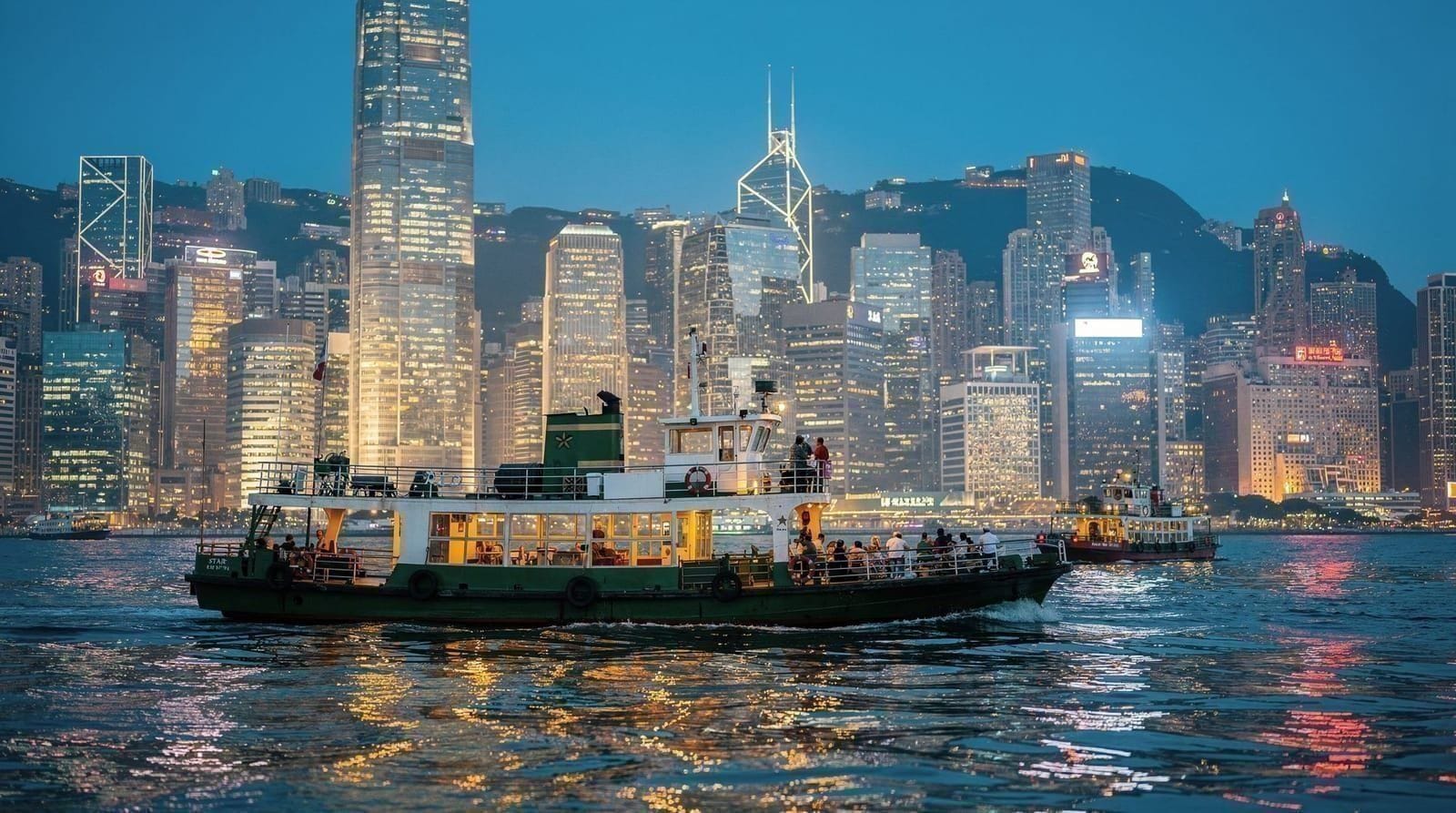
Hong Kong: Heritage highlights tour with Peak Tram and Star Ferry
The world’s longest-running double-decker tram
The Hong Kong Tramways system has been operating since 1904. It runs along a single east-west corridor on Hong Kong Island — from Kennedy Town in the west to Shau Kei Wan in the east — covering approximately 13km through some of the city’s most densely inhabited neighbourhoods. The double-decker trams, which locals call “ding dings” for the bell they ring at stops, have been running this route continuously through the Japanese occupation, the handover, the rise of the MTR, and multiple rounds of urban redevelopment.
In 2026, the tram is slower than ever (traffic has increased while the route hasn’t changed) and more loved than it’s been in decades, as the city’s density and the difficulty of preserving heritage objects has given the tram cultural weight it didn’t have when it was simply the standard way to get around.
The flat fare is HKD 3.30 — the cheapest public transport fare in Hong Kong and probably one of the cheapest urban journeys in any major city.
| Where | Kennedy Town to Shau Kei Wan (13km) |
| Cost | Flat HKD 3.30, pay on exit |
| Time needed | 60–90 min full route; hop on/off for less |
| Best seat | Upper deck, front row |
| Best time | 08:00–10:00 or 19:00–21:00 weekdays |
The route and what you see
The full route from Kennedy Town to Shau Kei Wan takes approximately 60–90 minutes, depending on traffic. Most riders don’t do the whole route in one sitting — they board and exit at convenient stops. But if you have 90 minutes and want a moving cross-section of Hong Kong Island, the full journey is worth doing once.
Kennedy Town (西環): The western terminus. Kennedy Town was one of the last areas of Hong Kong Island to receive MTR access (Island Line extension opened 2014) and retains a more local character than the central districts. The swimming shed, the morning market on Cadogan Street, the remnant neon on the commercial blocks.
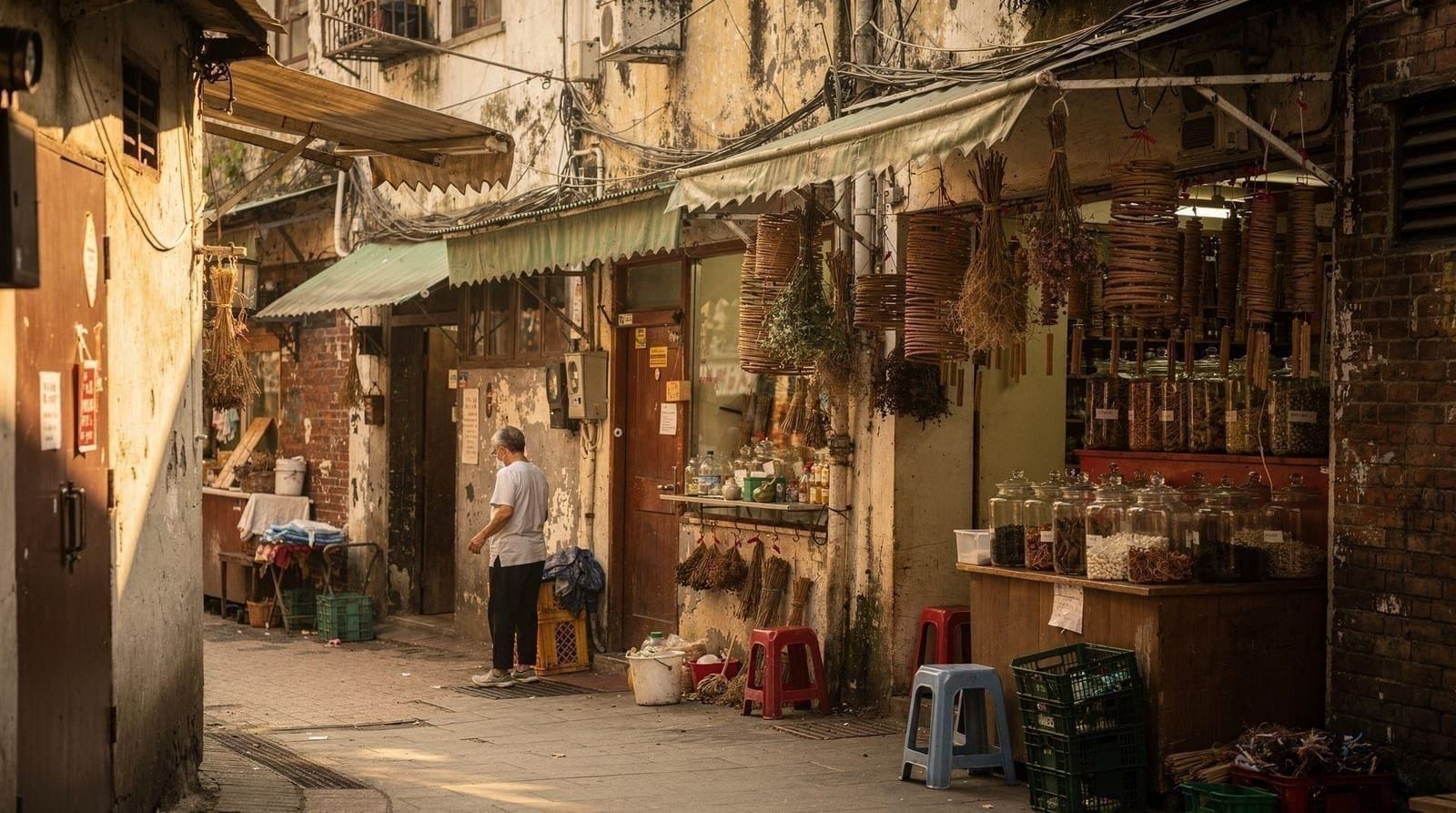
Sheung Wan (上環): The oldest part of Hong Kong Island to be developed after the 1841 colonial establishment. The stretch through Sheung Wan passes dried seafood shops (shark fin, abalone, sea cucumber) on Bonham Strand and Des Voeux Road West. The smell is distinctive and polarising. The Man Mo Temple is a short walk uphill.
Central (中環): The tram bisects the CBD at street level. The contrast between the colonial-era buildings (HSBC, Standard Chartered, the old Legislative Council building) and the 21st-century glass towers is most apparent from the tram upper deck, where you can see across the shopfront level to the tower facades above.
Wan Chai (灣仔): The old Wan Chai — before gentrification — was a neighbourhood of dai pai dong street stalls, traditional trades, and the entertainment district associated with its colonial nightlife history. Much of the old fabric has been replaced by commercial towers, but the stretch between Johnson Road and Lockhart Road still has working market buildings and traditional shops alongside the bars. The Blue House heritage cluster is a short walk from the tram.
Causeway Bay (銅鑼灣): Hong Kong’s densest commercial shopping district. The tram goes through the middle of it, at street level, which means the ride slows to a crawl during retail hours. This is either a feature (more time to watch the street) or a problem (you have somewhere to be). Victoria Park is nearby.
North Point (北角): One of the densest residential areas in Hong Kong. The streets here, off the tram route, have a strong Shanghainese character from the 1949 migration community. Old Shanghai-style restaurants survive alongside Cantonese ones.
Shau Kei Wan (筲箕灣): The eastern terminus. A working-class waterfront district with a fishing history. The tram depot is here — if you’re interested in the vehicles themselves, the area around the depot gives you a view of the full fleet. The Ten Thousand Buddhas Monastery is accessible from Sha Tin by MTR, not here, but Shau Kei Wan has its own temple cluster worth a brief exploration.
Upper deck: always, always
The tram is a double-decker. The lower deck is fine for a short hop but misses the point entirely. The upper deck, front row, gives you:
- Eye-level with the shop signs on the second and third floors of shophouses
- A view over car rooftops that the street pedestrian can’t see
- The sensation of moving slowly through the city’s commercial and residential fabric at human scale
On weekends and at peak hours, the front row fills quickly. Arrive at the terminus (Kennedy Town or Shau Kei Wan) for the best chance of the front seats.
How to pay
The Hong Kong Tram is one of the few remaining pay-on-exit systems in Hong Kong. You board through any door, ride, and then tap your Octopus card or deposit coins into the exit machine when you leave. If you forget to pay on exit, you still pay at the next point of exit you use — there’s no real enforcement mechanism, but the HKD 3.30 fare is so minimal that evasion seems pointless.
The Octopus card guide covers the card setup, which is far more convenient than coins.
Happy Valley — the branch line
There’s a short branch line to Happy Valley (跑馬地), the Hong Kong Jockey Club’s famous racecourse. The Happy Valley branch departs from the main line near Causeway Bay and terminates at the racecourse. On race nights (Wednesday evenings during the racing season, September through July), the approach to Happy Valley by tram — seeing the floodlit track appear at the end of the line — is oddly dramatic.
The racecourse grandstand is open to visitors on race nights for HKD 10 (public stand admission). Happy Valley races are one of the cheapest live sport experiences in Hong Kong.
The tram in history
The Hong Kong Tramways Company, established 1902, began service in 1904. The original trams were single-deck; the current double-deck configuration dates from the 1920s. During the Japanese occupation (1941–1945), the trams continued running under Japanese military administration. Post-war, the system expanded and the trams became a major part of Hong Kong’s commuter infrastructure until the MTR opened in 1979.
The trams have never been particularly fast — they were always slower than buses — but their role as a cheap, reliable connector through the densely populated parts of Hong Kong Island gave them a durability that alternatives lacked. Several proposals to replace or eliminate the tram system have been made and rejected over the decades. The most recent serious redevelopment pressure came in the 2000s; by the 2010s, the tram’s heritage value was being recognised alongside its functional role.
The exploring old Hong Kong post covers more of this context.
Practical tips
When to ride: Weekday mornings (08:00–10:00) have a commuter-crowd energy that’s part of the experience. Weekend afternoons (13:00–17:00) are pleasant but slower through Causeway Bay. Evening (19:00–21:00) on a weekday gives you the lit shopfronts without the extreme crowds.
What to look for from the upper deck: The second-floor level of shophouses is where the older signage survives — look for neon signs for traditional businesses, dentist offices, and tailors that haven’t upgraded their signage in decades. See the neon signs story for context.
Photography on the tram: The upper deck front window makes for time-lapse photography opportunities. A suction mount for a phone/camera works well if you want a hands-free shot. The movement is consistent (3–5 km/h through busy sections) and fairly smooth on a maintained track.
Combine with: Star Ferry from Central Pier after riding west to Central, then the tram east afterward makes a natural Hong Kong Island loop.
The tram is one of those things that doesn’t need to be justified as a “must-do” — it’s just useful, pleasant, and costs HKD 3. Ride it.
Tram versus MTR versus bus
| Cost | Speed | What you get | |
|---|---|---|---|
| Tram | HKD 3.30 flat | Slowest (3–5 km/h in busy sections) | Street-level views, atmosphere |
| MTR Island Line | From HKD 4.0 with Octopus, by distance | Fastest | No views, underground |
| Bus | Fare on the operator site | Faster than tram, slower than MTR | Some views, no upper deck |
The tram is never the fastest option and it isn’t trying to be. Use the MTR when you need to actually get somewhere on schedule; use the tram when the journey is the point.
A sample short route for limited time
If 90 minutes is too much, a good compressed version runs from Central to Causeway Bay — about 20–25 minutes covering the CBD contrast, the old Wan Chai fabric, and the entrance to Hong Kong’s densest shopping district. Board at a Central stop, sit upper deck front row, and get off near Times Square in Causeway Bay. This captures most of what makes the tram worthwhile without committing to the full end-to-end run.
Neighbourhoods worth a stop along the way
The tram passes through areas most visitors otherwise skip entirely. Wan Chai rewards a stop for the Blue House heritage cluster and the surviving dai pai dong stalls between Johnson Road and Lockhart Road. Sheung Wan, reached in the tram’s western stretch, has the dried seafood shops on Des Voeux Road West and the Man Mo Temple a short uphill walk away. Both are five-minute detours from the tram line rather than destinations that need a dedicated trip.
Photography and neon hunting from the tram
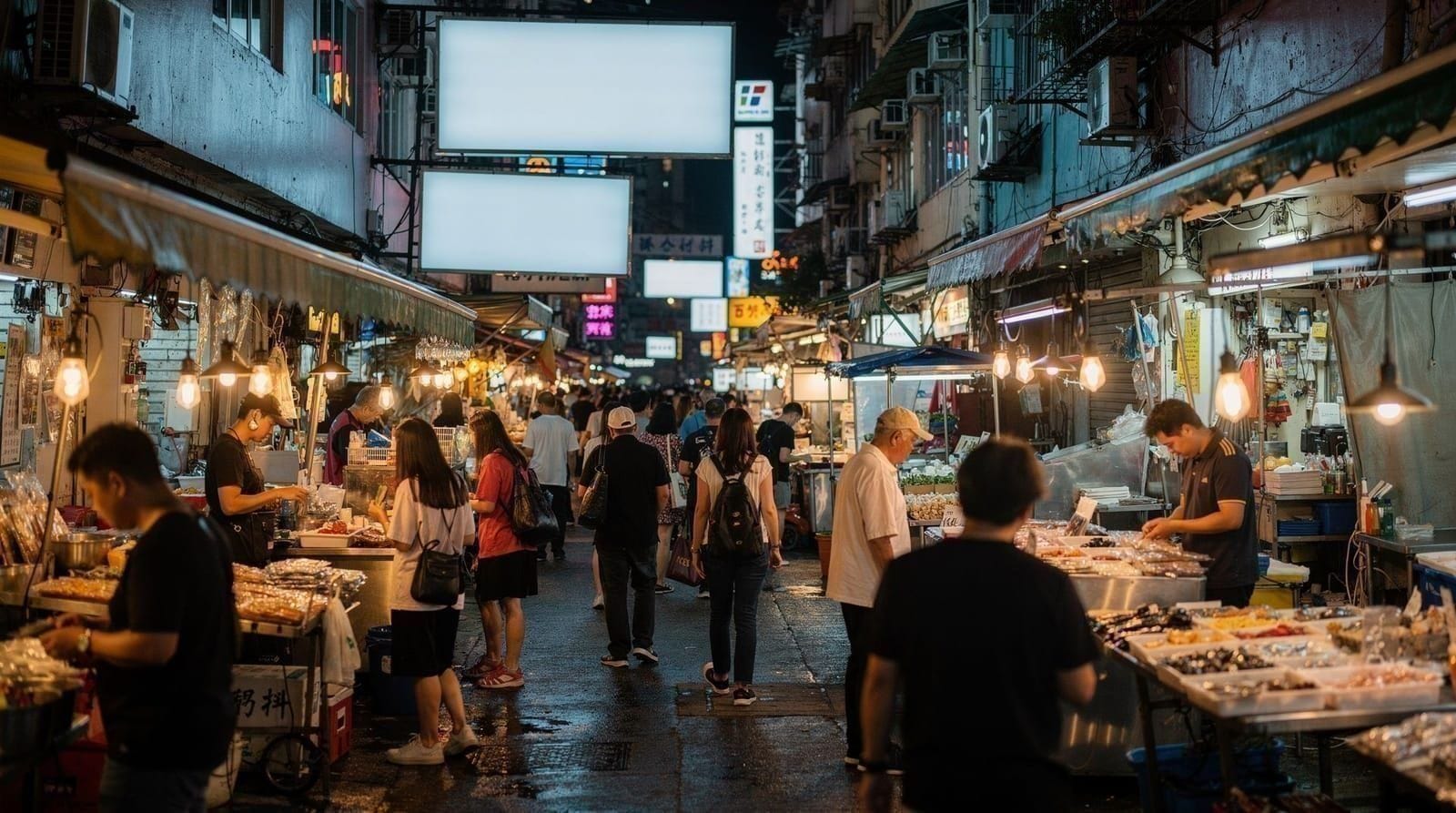
The upper deck front window is one of the best vantage points in the city for the surviving neon signage that Hong Kong is known for — much of it concentrated at second- and third-floor shophouse level, invisible from the pavement. The stretch through Sheung Wan and Mong Kok has the highest concentration of older signs still lit. Combine a tram ride with the neon signs story for the background on why so much of this signage has already disappeared, and what’s left worth photographing before it goes too.
Combining the tram with a full Hong Kong Island day
A natural loop: take the Star Ferry from Kowloon to Central in the morning, spend a few hours around Central and Sheung Wan, then pick up the tram east through Wan Chai and Causeway Bay toward North Point or Shau Kei Wan in the afternoon, finishing with dinner in whichever neighbourhood you land in. This uses the harbour crossing and the tram as bookends to a full Hong Kong Island day rather than treating either as a standalone activity — see the Hong Kong Island ferries guide for how the ferry network connects into this.
Where the tram fits in a wider Hong Kong plan
The tram works best as a slow interlude between busier days. If you are still shaping your trip, the first-time Hong Kong guide and the Hong Kong MTR guide explain how the tram sits alongside the faster networks. The Star Ferry and trams guide pairs the two classic rides in one place.
Short on days? The one-day itinerary and the first-timer itinerary are easy to adapt with a tram stretch between Central and Causeway Bay. On a wet day, the upper deck keeps you dry while the city streams past, and the rainy-day itinerary has other ideas for the same weather.
Travellers who like the tram’s unhurried pace often enjoy the Causeway Bay area guide for what to do once you step off, and the Soho and Central guide for the western end of the ride. If the street-level food along the route tempts you, the dai pai dong guide and the cha chaan teng guide are good companions. For golden-hour views after your ride, see best sunset spots in Hong Kong.
If you want the tram as part of a guided day
The tram needs no ticket, but some travellers prefer to fold it into a structured outing. A half-day city tour that combines the Peak Tram and the Star Ferry pairs well with a separate ding ding ride, and you can book a half-day city highlights outing with the Peak Tram and Star Ferry if you would rather not plan the connections yourself. Riders who like seeing the city from a seat can compare it with a hop-on hop-off bus tour with an optional Peak Tram ride, which covers similar ground at a different pace.
After the tram, many visitors head up to the viewpoint. The Peak Tram guide and the Victoria Peak guide explain the options, and a Peak Tram and Sky Terrace 428 ticket is the simplest way to sort the ride and the viewing platform in one go. Whether the Peak is worth the effort for you is covered in is the Peak Tram worth it, and the top things to do in Hong Kong puts the tram alongside the other classics. For a gentler way to spend an evening, the Symphony of Lights guide is a natural follow-on to a tram ride toward the harbour.
Frequently asked questions about ding ding tram journey — Hong Kong Island’s slowest best ride
Is the Hong Kong tram worth riding if I’m short on time? Yes — even a 20-minute stretch between Central and Causeway Bay captures the essential experience: upper deck views, street-level density, and the HKD 3.30 fare. You don’t need the full Kennedy Town–to–Shau Kei Wan run to get the point.
How do I pay on the Hong Kong tram? Board through any door, then tap your Octopus card or drop coins in the box as you exit — it’s a pay-on-exit system, unlike the MTR or buses where you pay first.