Ten Thousand Buddhas Monastery guide — Sha Tin's hillside treasure
Hong Kong: Cultural heritage historical site private walking tour
Duration: 1.5 hours
How do I visit Ten Thousand Buddhas Monastery?
Take the MTR East Rail Line to Sha Tin station, walk 15 minutes following signs to the monastery, then climb approximately 430 steps lined with golden Buddha statues. Entry is free. Open daily 09:00–17:30. The climb takes 20–30 minutes and is not recommended for visitors with mobility difficulties.
An unusual approach to Buddhism
Ten Thousand Buddhas Monastery (Mun Fat Monastery) is not the quietest or most architecturally refined temple in Hong Kong, but it is arguably the most visually arresting. The staircase leading up to the monastery complex is lined with over 12,800 individual golden Buddha statues — each one roughly 60cm high, each in a slightly different pose, each with a slightly different facial expression. Walking up through this corridor of gold on a quiet morning, with the surrounding forest of Sha Tin on either side, is a genuinely memorable experience.
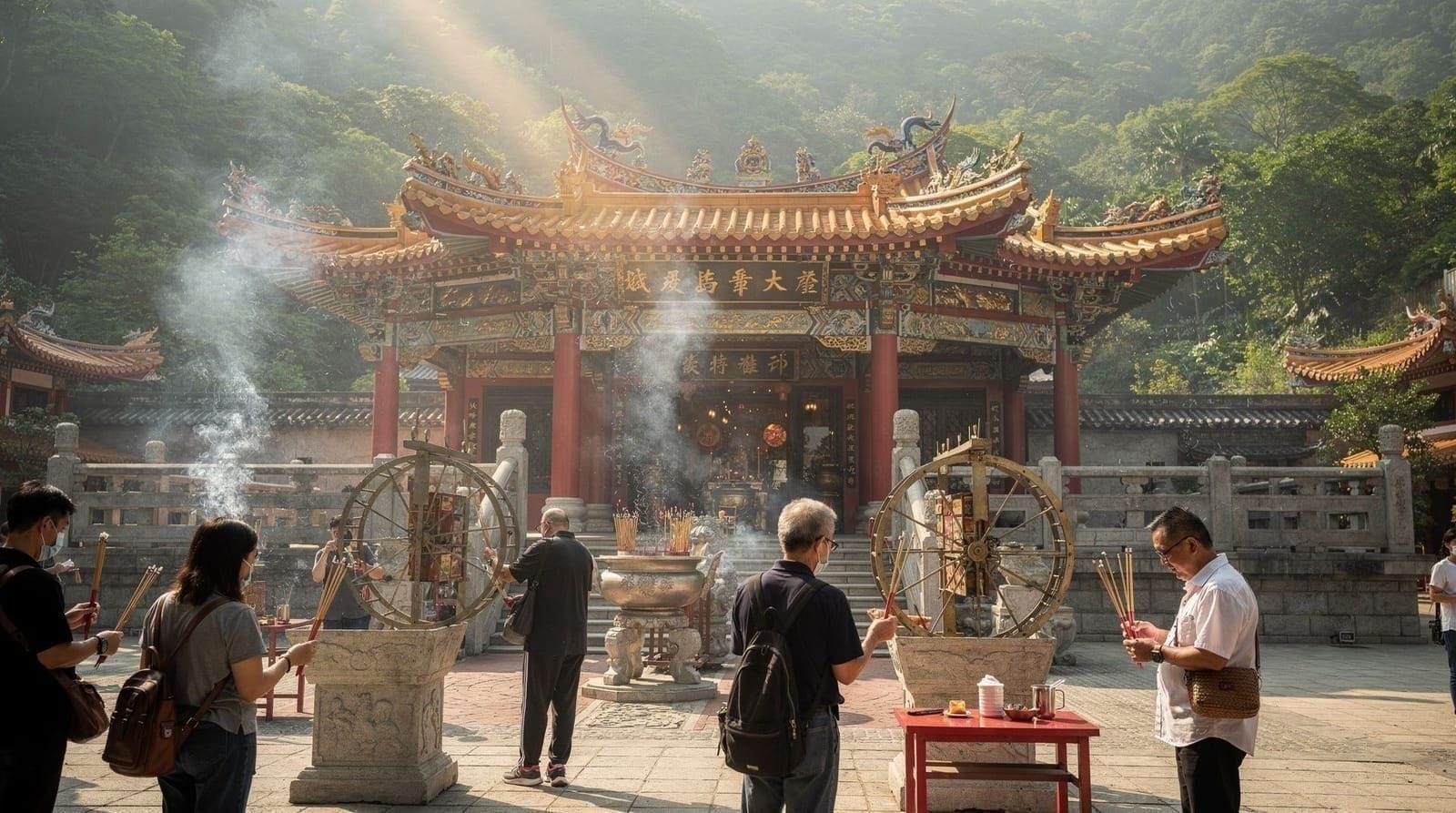
The monastery is active — not a preserved relic or a museum recreation. Monks and nuns live and practice here. The founder’s preserved body is in the main hall. Donations fund ongoing additions to the statue collection. This is not a heritage site; it is a working monastic community that happens to be one of the most visually distinctive in the region.
| Where | Sha Tin, New Territories |
| Cost | Free (donations welcome) |
| Time needed | 2–2.5 hours round trip including the climb |
| Getting there | MTR East Rail Line to Sha Tin, then 12-min walk + climb |
| Best time | Weekday mornings 09:00–11:00 |
Getting to Sha Tin and the monastery
The starting point is Sha Tin station on the MTR East Rail Line (Lo Wu/Lok Ma Chau line). From Hong Kong station (Central) the journey takes approximately 35–40 minutes. From Tsim Sha Tsui (East Tsim Sha Tsui station, change at Hung Hom) about 30 minutes.
From Sha Tin station:
- Exit via the Pai Tau exit (or follow signs for “10,000 Buddhas Monastery” — the monastery is signposted from the station).
- Walk along Pai Tau Street heading away from the New Town Plaza mall.
- Continue on Pai Tau Street past Sha Tin Town Hall and the library complex — approximately 10–12 minutes.
- At the end of Pai Tau Street, the monastery access path begins on the right, marked with a sign. The staircase ascent starts here.
The walk from the station to the start of the staircase is flat, about 1km, and takes 12–15 minutes. The staircase itself begins immediately after and climbs directly into the hillside.
Taxi: From Sha Tin station, taxis cannot go to the monastery gate (the path is pedestrian only). The same walk applies.
No public bus serves the monastery gate directly. The MTR walk route is the only practical approach.
The staircase: expectations and preparation
The staircase climbs approximately 430 steps over a vertical rise of around 80–100 metres. The steps are stone, some original and worn, some replaced. Handrails run the full length. In good condition and normal weather, a moderately fit adult can manage the climb in 20–30 minutes with brief pauses.
Bring water. There are no shops or vendors on the staircase. One small refreshment stall operates at the top during busy periods but cannot be relied upon. The climb is exposed in the upper sections and hot in summer.
Footwear: Closed shoes with grip are advised. Flip-flops are uncomfortable on the uneven steps and dangerous in wet weather.
Not recommended for: Visitors with significant knee or hip problems, young children without good independent walking ability, anyone in poor cardiovascular condition on a hot day. There is no alternative route (no cable car, no lift).
Weather: After rain, the steps become slippery. Allow extra time and consider waiting if heavy rain has fallen in the past few hours.
The statues on the staircase
The statues lining the staircase are the central visual experience of the visit. Each is approximately 60–70cm tall and gilded, set into individual niches along both sides of the path. The variation within uniformity is what makes the effect work — the 12,800+ statues share a general form (seated Buddha or bodhisattva) but individual poses, hand gestures (mudras), and facial expressions differ. Some hold objects (lotus flowers, books, begging bowls); some are serene, some slightly severe, a few almost playful.
Donor names are inscribed on each statue base — these are dedication offerings, similar in concept to purchasing a memorial pew. The practice of accumulating a large number of Buddha images for merit is an established Chinese Buddhist tradition.
The first section of the staircase passes through denser forest; as you ascend the views open toward Sha Tin’s new towns below. The towers and shopping complexes visible from the upper sections create an incongruous contrast with the gilded figures — one of Hong Kong’s characteristic juxtapositions of very old religious practice against very recent city.
At the top: the monastery complex
The upper complex contains several buildings around a central courtyard:
Main Hall (Yue Kai Memorial Hall): The primary shrine hall houses a large gilded seated Shakyamuni Buddha on the main altar. In a glass case to one side, the preserved and gilded body of Yuet Kai — the monastery’s founder (died 1965) — is displayed. This is a legitimate Buddhist practice: the bodies of exceptionally virtuous masters are sometimes preserved by immersing in salt and lacquer, then gilded. Yuet Kai was a Chan Buddhist monk who established the monastery in 1949. The practice is not universally observed in Chinese Buddhism; its presence here is notable and sometimes unexpected for first-time visitors. Photography near the preserved figure is generally not appropriate.
Nine-Story Pagoda: The pink octagonal pagoda visible from Sha Tin below is not the oldest structure in the complex but is the most distinctive. Each level contains additional statues. The exterior viewing platform at higher levels offers views over Sha Tin’s layout. Not all levels are accessible to visitors — check signs at the base.
Kwun Yam Hall and Tai Sui Hall: Side halls housing Guanyin (the bodhisattva of compassion) and the 60 Tai Sui deities (one for each year of the Chinese zodiac’s 60-year cycle). The Tai Sui Hall is a point of active worship — visitors born in the current year’s zodiac sign make offerings at the relevant deity’s statue.
Terrace and views: A paved terrace to the east of the main hall has seating and views over the Shing Mun River and Sha Tin’s residential towers. Good for a break after the climb.
Sha Tin’s food and what to do after the monastery
The descent brings you back to Pai Tau Street, from which Sha Tin’s New Town Plaza mall is a 10-minute walk. New Town Plaza (a large shopping complex adjacent to Sha Tin station) has a comprehensive food court on the upper floors — reasonable prices, reliable Cantonese options, and several Taiwan/Japanese food chains.
More interesting food is found on the streets around Sha Tin town centre:
Wai Kee Noodle Cafe (Sha Tin: various branches near the station) serves wonton noodle soup and roast meat rice at HK$40–60 per dish — standard Hong Kong staple but reliably done.
Sha Tin Racecourse (weekends): When there are races (typically Saturday and select Wednesdays September–July), the racecourse at Sha Tin is worth visiting. Entry HK$10. The atmosphere of a live Hong Kong race meeting is culturally specific and interesting — this is not tourist-packaged gambling but genuine local racing culture.
Shing Mun Reservoir: A scenic reservoir park about 15–20 minutes by bus from Sha Tin (Bus 82 from Sha Tin station area). The reservoir trails are an easy 2–3 hour walk through secondary forest. Macaques inhabit the area — do not feed them.
Combining Ten Thousand Buddhas with other temples
The monastery works well as a standalone half-day from anywhere in Hong Kong (35–40 min MTR each way). It does not combine naturally in a single day with Chi Lin Nunnery (Diamond Hill) or Wong Tai Sin Temple — the distances work against it.
A more logical combination is Ten Thousand Buddhas Monastery in the morning (09:00–12:00) followed by lunch in Sha Tin and an afternoon at the Sai Kung Geopark — taking Bus 299X from Sha Tin station to Sai Kung (40 minutes). This makes a full New Territories day that covers both religious heritage and natural scenery.
Alternatively, combine with Sha Tin destination content for context on the broader New Territories area.
If the monastery leaves you curious about how religion and settlement shaped the territory, a guide adds real context that the sparse English signage here does not. One way to place the monastery alongside older temples and heritage buildings is a private walking tour of the city’s historical and cultural sites, which suits travellers who prefer explanation to wandering on their own. For a village-scale view of rural traditions in the New Territories, a guided visit to a Hakka village pairs naturally with a temple morning, though it is a separate outing rather than an add-on to the same day.
Fitting the monastery into a longer trip
If you are still shaping your plans, the first-time Hong Kong guide and the Hong Kong itinerary planning guide show where a half-day in the New Territories sits best. Because the monastery asks for a morning rather than a full day, it slots easily into a 3-day Hong Kong itinerary as the slower, greener counterpoint to the city-centre days.
Temple-minded travellers may also enjoy Man Mo Temple on Hong Kong Island, which offers a very different, incense-filled urban atmosphere. Since the climb here is exposed, it also helps to read the best time to visit Hong Kong before choosing your date, and the MTR guide if you are unsure how to ride the East Rail Line.
Practical information
- Address: 220 Pai Tau Village, Sha Tin, New Territories
- MTR: Sha Tin station, East Rail Line, Pai Tau exit — then 12 min walk + 20–30 min climb
- Hours: Daily 09:00–17:30
- Entry fee: Free (donations appreciated)
- Climb: ~430 steps, 20–30 minutes one way; handrails throughout
- What to bring: Water, comfortable shoes with grip, sun protection
- Best time: Weekday mornings (09:00–11:00); October–February for comfortable temperatures
- Not recommended for: Visitors with significant mobility difficulties or knee problems
A note on respectful visiting
Ten Thousand Buddhas Monastery is not a museum, and behaving accordingly matters. Keep voices moderate near the halls and the preserved-body shrine, avoid stepping into areas roped off from public access, and dress reasonably modestly (shoulders and knees covered is a safe default, though enforcement is relaxed compared to some Southeast Asian temples). Photography is generally welcomed on the staircase and in the courtyards, but avoid photographing the preserved body of Yuet Kai directly, and be alert to any signage restricting photography inside specific halls.
How it compares to Hong Kong’s other major temples
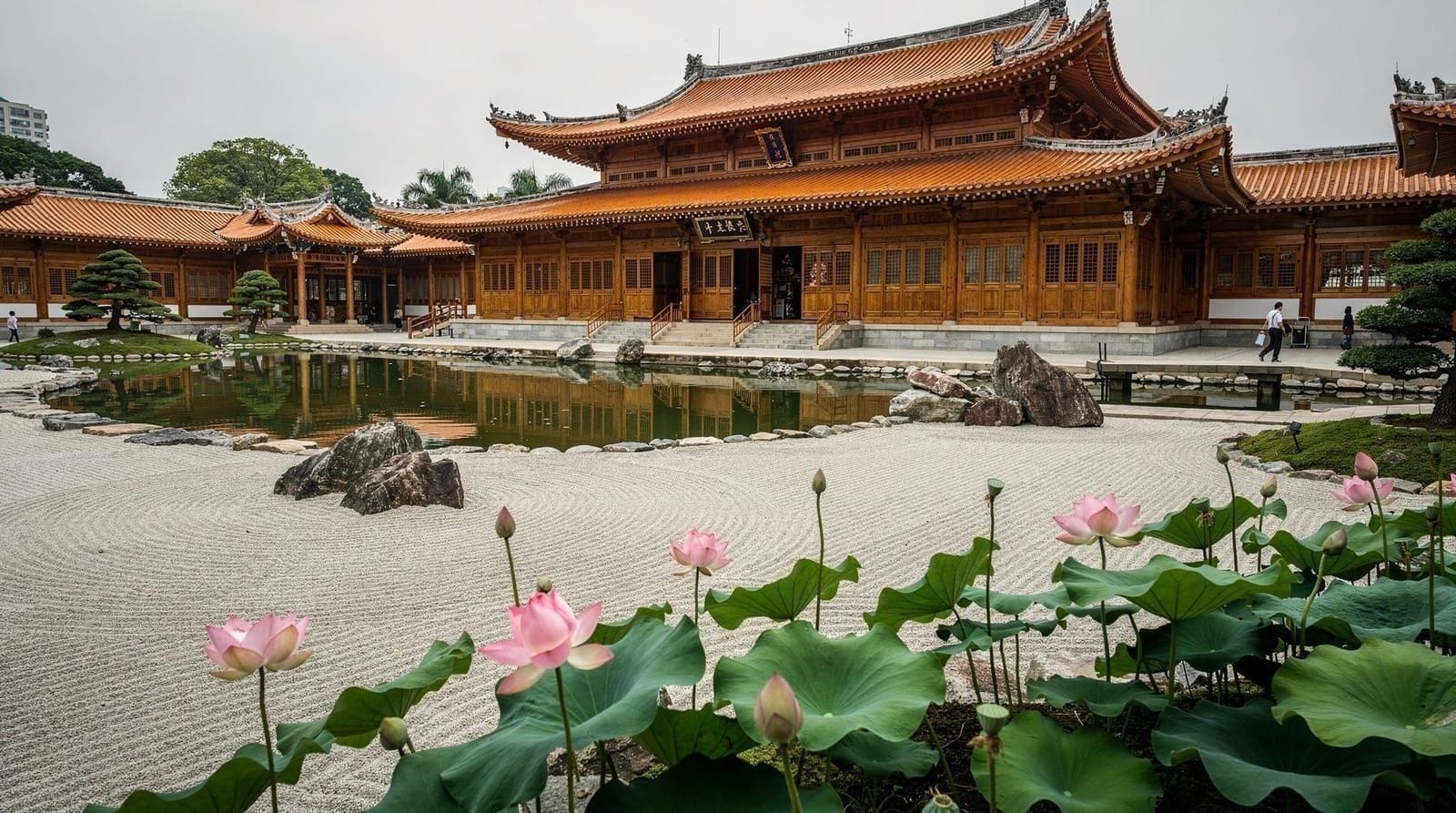
Hong Kong has several temple experiences worth comparing before choosing where to spend a morning. Chi Lin Nunnery in Diamond Hill is flat, wheelchair-accessible, and architecturally serene — Tang-dynasty-style wooden halls set around still ponds, with none of the climb or crowd density found here. Wong Tai Sin Temple is the opposite in character — a loud, actively worshipped Taoist complex with fortune-telling stalls, best for observing daily religious practice rather than quiet contemplation.
Ten Thousand Buddhas Monastery sits between the two: an active Buddhist site like Wong Tai Sin, but requiring genuine physical effort to reach, with a visual spectacle (the 12,800+ statues) unlike anything at either of the other two. If you can only manage one temple and mobility is a concern, choose Chi Lin. If you want the most visually distinctive experience and can handle 430 steps, this is the one.
Is the climb worth it for non-religious visitors?
Visitors without any particular interest in Buddhism sometimes ask whether the climb is worth the effort if the appeal is purely visual or photographic. The honest answer is yes, but manage expectations: this is not a polished, curated attraction with facilities at every turn. It is a genuinely active monastery with uneven surfaces, sparse signage in English beyond the basics, and no amenities beyond a single unreliable refreshment stall.
What you get in exchange is a visual experience — the golden statue corridor — that has no real equivalent elsewhere in Hong Kong or, arguably, most of Asia. Photographers in particular tend to rate this highly among Hong Kong’s free attractions specifically because the repetition-with-variation of the statues photographs so well in early morning side light.
Hong Kong heritage: past to present guided tourFrequently asked questions about Ten Thousand Buddhas Monastery guide — Sha Tin's hillside treasure
How many Buddha statues are there actually?
How steep is the climb to Ten Thousand Buddhas Monastery?
Is Ten Thousand Buddhas Monastery free?
How long should I allow for the visit?
When is the best time to visit?
What is inside the monastery complex at the top?
How does Ten Thousand Buddhas Monastery differ from other Hong Kong temples?
Top experiences
Bookable activities with verified prices and instant confirmation on GetYourGuide.