Man Mo Temple guide — Hong Kong's oldest temple in Sheung Wan
Hong Kong: 3 hour Hong Kong Island historical and cultural tour
Duration: 3 hours
What is Man Mo Temple and is it free to visit?
Man Mo Temple is Hong Kong's oldest and most famous Taoist temple, built in 1847 in Sheung Wan on Hollywood Road. Entry is free and it opens daily 08:00–18:00 (07:00 on the 1st and 15th of the lunar month and some festivals). Allow 30–45 minutes. It is a working place of worship, not a museum.
The oldest temple still standing in Hong Kong
Man Mo Temple was built in 1847, making it one of Hong Kong’s oldest surviving structures. It predates most of the city’s colonial-era architecture and has been a continuous centre of neighbourhood religious life for nearly 180 years. Unlike many temples that have been significantly rebuilt, Man Mo retains its original footprint on Hollywood Road and much of its 19th-century material fabric.
| Where | 124–126 Hollywood Road, Sheung Wan |
| Cost | Free |
| Time needed | 20–30 minutes; 2–3 hours with Hollywood Road antiques |
| Getting there | MTR Sheung Wan station, exit A2 (10 min walk) |
| Best time | Weekday mornings before 10:00 for a quiet visit |
The temple sits on what was once the edge of Sheung Wan’s Chinese quarter — separated from the British administrative area of Central by a deliberate urban boundary. Its location reflects the social geography of early colonial Hong Kong: Chinese residents worshipped here while colonial governance occupied the ridge above. The temple served as a community centre, an alternative legal arbitration space (disputes were settled here before colonial courts were accessible to Chinese residents), and a place of public oath-taking.
Today it functions primarily as a neighbourhood temple — local residents stop on the way to work, elderly regulars maintain daily routines, and tourism traffic is significant but does not dominate the atmosphere on weekday mornings.
Getting there: Hollywood Road options
MTR + Walk: The most straightforward route is Sheung Wan station (Island Line, exit A2). From the exit, walk uphill along Morrison Street, turn left on Hollywood Road — the temple is 8–10 minutes on your right at no. 124–126.
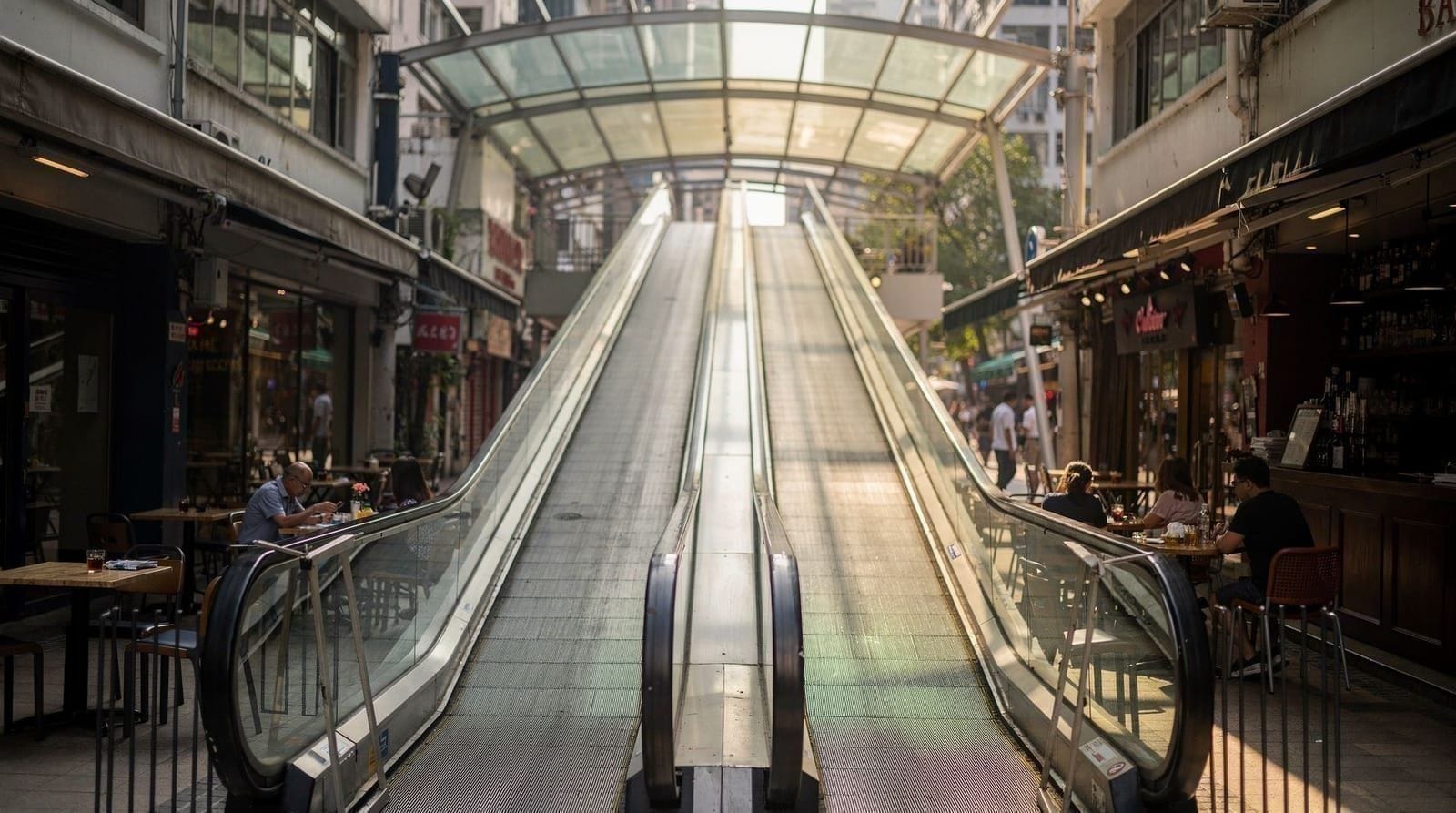
Central–Mid-Levels Escalator: If you are already in SoHo or Mid-Levels, the escalator brings you down to Hollywood Road at Cochrane Street. The temple is a 10-minute walk west from there. This is the more scenic approach.
Bus: Routes 26 and 40 travel along Hollywood Road. The stop immediately adjacent to the temple is called “Man Mo Temple.”
Taxi: Metered fare, starting at HK$29 for the first 2 km (harbour-tunnel crossings add a supplement). Tell the driver “Man Mo Temple, Hollywood Road, Sheung Wan” — most will know it.
Inside the temple: what you’re looking at
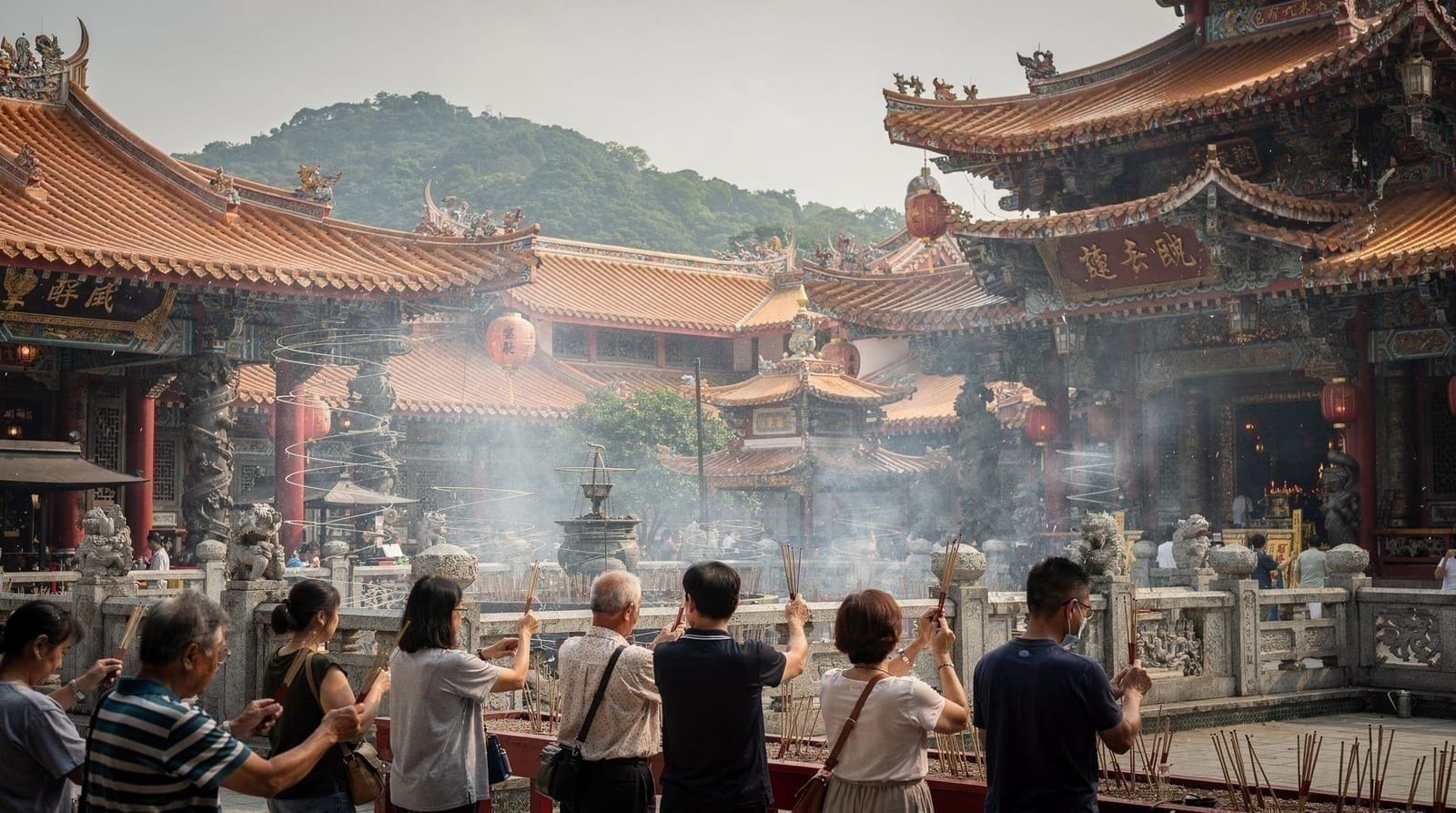
Man Mo Temple is small — the main hall is perhaps 15 metres deep and 10 metres wide — but densely layered. The impact is immediate: the interior is amber-hued from incense smoke, hung with dozens of spiral coils, and lit by clusters of red lanterns. On a first visit it takes a moment to adjust to the dimness.
The two main shrines: The altar on the left (facing in) is dedicated to Man Cheong, god of literature. He is depicted as a scholarly figure in green robes holding a writing brush, often flanked by attendants. The right altar holds Mo Tai — General Guan Yu — depicted with a red-painted face, armoured, typically holding a glaive. The pairing was and remains significant: Man represents intellectual achievement, Mo represents martial honour and righteousness. Together they stood for complete virtue in the Confucian-Taoist moral framework.
Secondary shrines and side halls: Behind the main hall, a passage leads to two smaller auxiliary halls — Kung Sor (公所), a former community meeting room used for resolving disputes, and Lit Shing Kung (列聖宮), housing shrines to additional Taoist deities. These rooms are quieter and less visited than the main hall.
The incense coils: The hanging spiral coils are the temple’s most visually arresting feature. Each coil takes 2–4 weeks to burn through. A paper tag dangling from the coil identifies the donor’s name and the written prayer. Worshippers purchase coils for significant prayers — long-lasting illness recovery, business success, examinations. Prices depend on size, starting around HK$200 for a small coil. The combined smoke of 20–30 burning coils simultaneously creates the haze that defines the interior atmosphere.
Bronze deer and cranes: A pair of bronze deer and cranes are placed on the altar — symbols of longevity and heavenly blessings respectively in Taoist iconography. These date to the 19th-century temple construction.
The Hollywood Road antique district
Man Mo Temple sits in the middle of Hollywood Road’s antique strip — a concentration of shops selling Chinese antiques, Ming and Qing dynasty ceramics, jade, furniture, silver, and an increasing number of curios and reproduction pieces.
The quality varies from genuinely significant pieces (handled by established gallery-style dealers) to tourist-grade souvenirs. The reputable dealers are concentrated in the 300–400 block of Hollywood Road (east of the temple) and on Wyndham Street continuing up toward Central. If you’re buying antiques seriously, know your period and ask about provenance explicitly.
Cat Street (Upper Lascar Row) is one block downhill from Hollywood Road and worth a brief detour. This open-air market sells vintage items, old coins, Mao-era memorabilia, and collectibles at negotiable prices. It is more flea market than antique gallery — good for browsing, less reliable for serious acquisitions.
3-hour Hong Kong Island historical and cultural walking tourThe neighbourhood context: Sheung Wan
Man Mo Temple’s neighbourhood, Sheung Wan, is one of the most historically layered parts of Hong Kong Island. The streets immediately around the temple have dried seafood and preserved goods shops (the pungent stretch of Des Voeux Road West where dried abalone and shark fin are displayed in shop windows), traditional Chinese medical halls, herbal tea shops, and a grid of streets that still follows the original 19th-century layout.
This part of Sheung Wan survived the property development cycles that eliminated most of Hong Kong’s older commercial streetscape. Walking west from Man Mo along Hollywood Road to the Sai Ying Pun neighbourhood — about 20 minutes — gives a sense of the older city that the tourist-focused areas of Central and Tsim Sha Tsui do not.
Practical eating nearby:
- Lin Heung Tea House (160 Wellington Street, Central): A 10-minute walk east, one of Hong Kong’s most traditional dim sum restaurants. Open from 06:00. Locals push dim sum carts; no English menus; genuinely busy. Prices HK$25–50 per dish.
- Sing Heung Yuen (2 Mee Lun Street, Central): Famous for tomato broth noodles and macaroni soup. Lines form early; arrive before 08:30 or after 09:30. Meals HK$40–60.
- Kau Kee Restaurant (21 Gough Street): Famous for beef brisket noodles. One of Hong Kong’s best known noodle shops, closed Sundays, often has a queue after 11:30.
What changes between lunar calendar dates
Visiting on the 1st or 15th of the lunar month will give a significantly different experience from an ordinary day. These are the two monthly peak worship dates in Cantonese religious practice — when worshippers make larger offerings, the fortune stick ritual is more active, and the temple is considerably busier. If you want to observe this heightened activity, it is worth planning around the lunar calendar.
On ordinary weekdays, especially before 10:00, the temple has perhaps 10–20 people at most. The fortune stick ritual (kau cim) is available here as at other Taoist temples, though Man Mo does not have a dedicated fortune teller arcade — the interpretation is more personal or done by the temple keeper on request.
Architectural details worth noticing
The roof: The green ceramic tile roof with its characteristic upturned ridge ornaments features two ceramic figures at each end — often dragons or fish — which in Chinese temple architecture are believed to protect against fire. The roof is visible from the street before you enter.
The entrance screen: A wooden screen just inside the entrance is typical of southern Chinese temple design. It prevents evil spirits from entering (spirits were believed to move only in straight lines). It also historically provided privacy from the street.
The door gods: The painted guardian figures on the main doors are traditional — red-faced, armoured, armed. These are renewed periodically by the temple administration.
The courtyard well: A small covered well in the side courtyard dates to the original temple construction. It is no longer in use but retained as part of the heritage fabric.
Roof ridge figures and grey brick walls: Look closely at the roof ridge and you’ll find ceramic figurines depicting scenes from Chinese opera and folklore, a common decorative tradition in Cantonese temple architecture of the period. The exterior walls are made from grey brick in the traditional southern Chinese style, distinct from the granite and red brick used in Hong Kong’s colonial civic buildings of the same era — a visible marker of who built for whom in 19th-century Hong Kong.
Etiquette for visiting a working temple
Man Mo Temple is not a museum piece — it is in daily use, and treating it accordingly matters. Speak quietly inside the main hall, especially near worshippers actively burning incense or making offerings. It is customary (though not compulsory for visitors) to bow slightly when passing the main altars. Photography of the architecture, coils, and general interior is fine; avoid pointing a camera directly at someone mid-prayer. If you wish to make an offering yourself, small denomination donations are welcome in the collection boxes near the entrance, and incense sticks can be purchased from the temple keeper for a modest fee.
Hong Kong heritage unveiled — private walking tourCombining Man Mo with a broader SoHo circuit
Man Mo Temple is at the western edge of what travel writers call the SoHo and SOHO district — the cluster of bars, restaurants, and galleries on and around Elgin Street, Staunton Street, and the Mid-Levels escalator. This makes it easy to combine a morning temple visit with a later circuit of PMQ (a design and creative complex in a former police quarters building at Aberdeen Street), the surrounding gallery streets, and lunch at one of the neighbourhood’s better restaurants before heading further.
For the broader Hong Kong Island context, Central and Sheung Wan covers the neighbourhood in more depth, and the SoHo and Central guide lists specific restaurants and bars in the area.
The Hong Kong festivals guide explains when the temple’s major annual celebrations fall and what to expect during the Tin Hau Festival in April/May, when many Kowloon and island temples hold simultaneous events.
Man Mo vs Hong Kong’s other major temples
| Temple | Character | Time needed | Best for |
|---|---|---|---|
| Man Mo | Small, intimate, 1847 | 20–30 min | Architecture, quiet atmosphere |
| Wong Tai Sin | Large, active, commercial | 1–2 hrs | Fortune-telling ritual, scale |
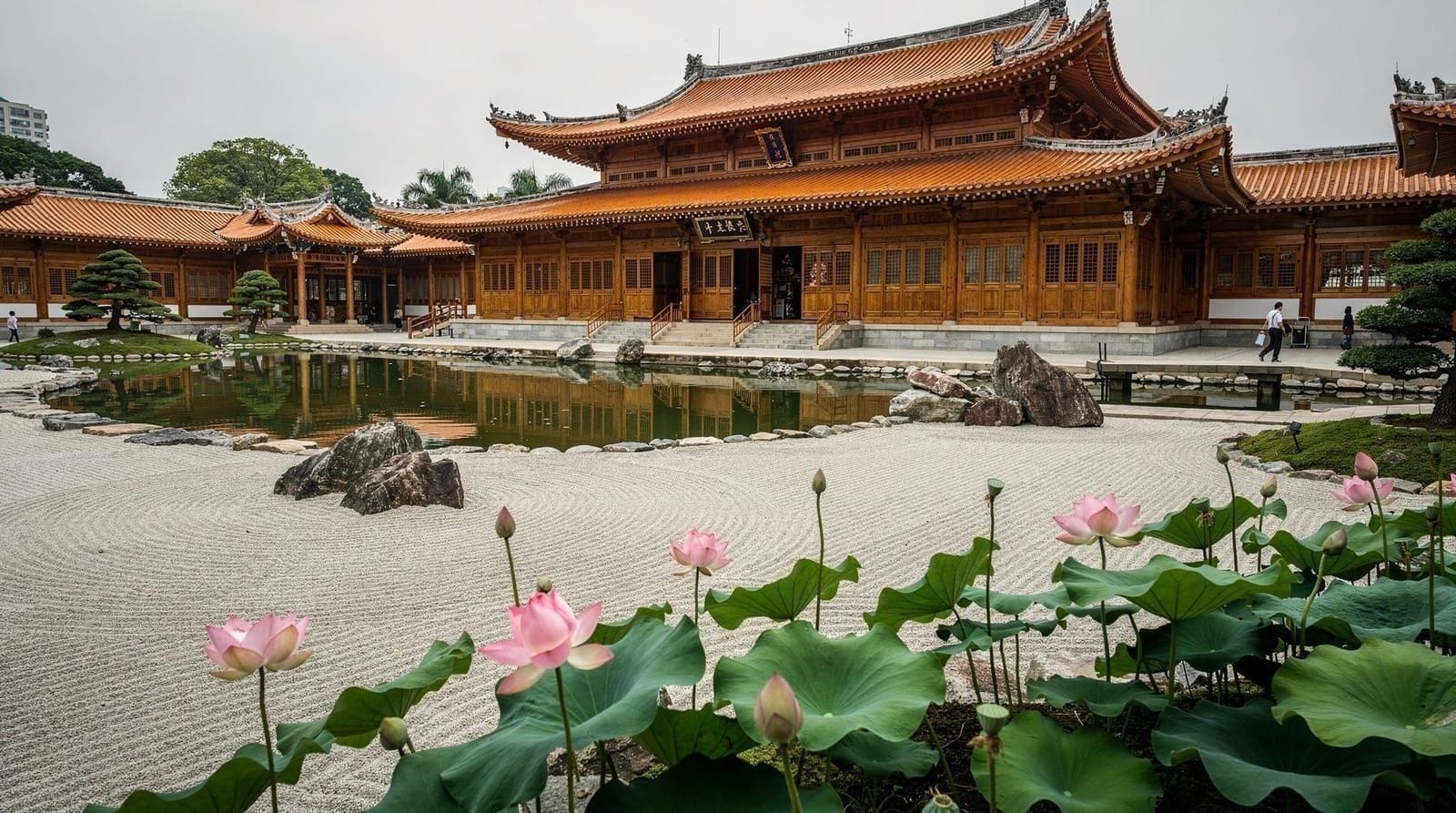
| Chi Lin Nunnery | Tang-dynasty style, serene | 45–60 min | Architecture, gardens |
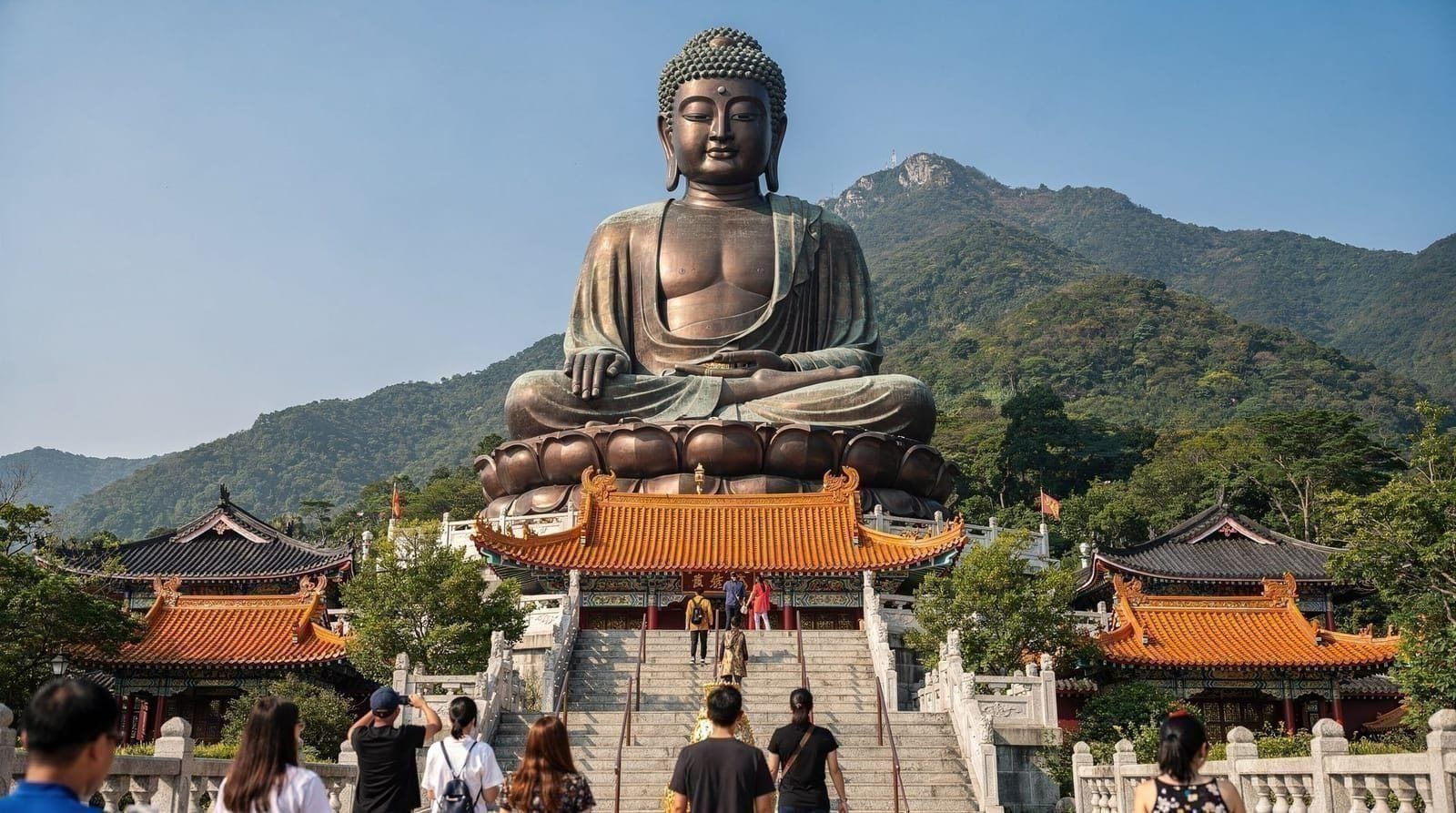
| Tian Tan Big Buddha | Monumental, Lantau | Half day | Landscape, monastery |
If you only have time for one temple in Hong Kong, Man Mo is the easiest to fit into a Hong Kong Island itinerary given its central Sheung Wan location, while Wong Tai Sin and Chi Lin Nunnery require a dedicated trip to Kowloon.
Practical information
- Address: 124–126 Hollywood Road, Sheung Wan, Hong Kong Island
- MTR: Sheung Wan station, Island Line, exit A2 (10 min walk)
- Hours: Daily 08:00–18:00 (07:00 on the 1st and 15th of the lunar month and some festivals)
- Entry fee: Free
- Photography: Permitted in general areas; avoid photographing worshippers during active prayer
- Allow: 30–45 minutes at the temple; 2–3 hours if exploring Hollywood Road antiques and Cat Street
- Best time: Weekday mornings before 10:00 for a quiet visit; 1st or 15th lunar day for peak activity
- Combine with: Wong Tai Sin Temple (Kowloon, different day), Chi Lin Nunnery (Diamond Hill, different day)
Frequently asked questions about Man Mo Temple guide — Hong Kong's oldest temple in Sheung Wan
How do I get to Man Mo Temple?
What are Man Mo Temple's opening hours?
Who are Man and Mo?
What are the giant coils of incense hanging from the ceiling?
Is Man Mo Temple suitable for children?
How does Man Mo Temple compare to Wong Tai Sin?
What else is near Man Mo Temple?
Do I need to dress a certain way to visit Man Mo Temple?
How long should I spend at Man Mo Temple?
Top experiences
Bookable activities with verified prices and instant confirmation on GetYourGuide.