Tian Tan Big Buddha guide — Ngong Ping, cable car, and Po Lin Monastery
Hong Kong: Big Buddha tour and skip-the-line NP360 cable car
How do I get to the Big Buddha and how much does it cost?
Take the MTR to Tung Chung (Tung Chung Line), then either the Ngong Ping 360 cable car (HK$295 standard or HK$365 crystal cabin return, about 20 minutes each way) or Bus 23 from Tung Chung Bus Terminus (45 minutes; check the operator's website for the fare). Climbing the 268 steps to the Buddha's base is free; for the interior exhibition and Po Lin vegetarian lunch prices, check the official Po Lin site. Allow a full day.
Planning a realistic Big Buddha day
The Tian Tan Big Buddha is one of Hong Kong’s most visited landmarks, and planning the visit wrong is easy. The most common mistake is arriving at Tung Chung station without advance research on a Saturday morning, walking to the cable car, and finding a 90-minute queue. This can consume a large portion of the morning before you’ve left ground level.
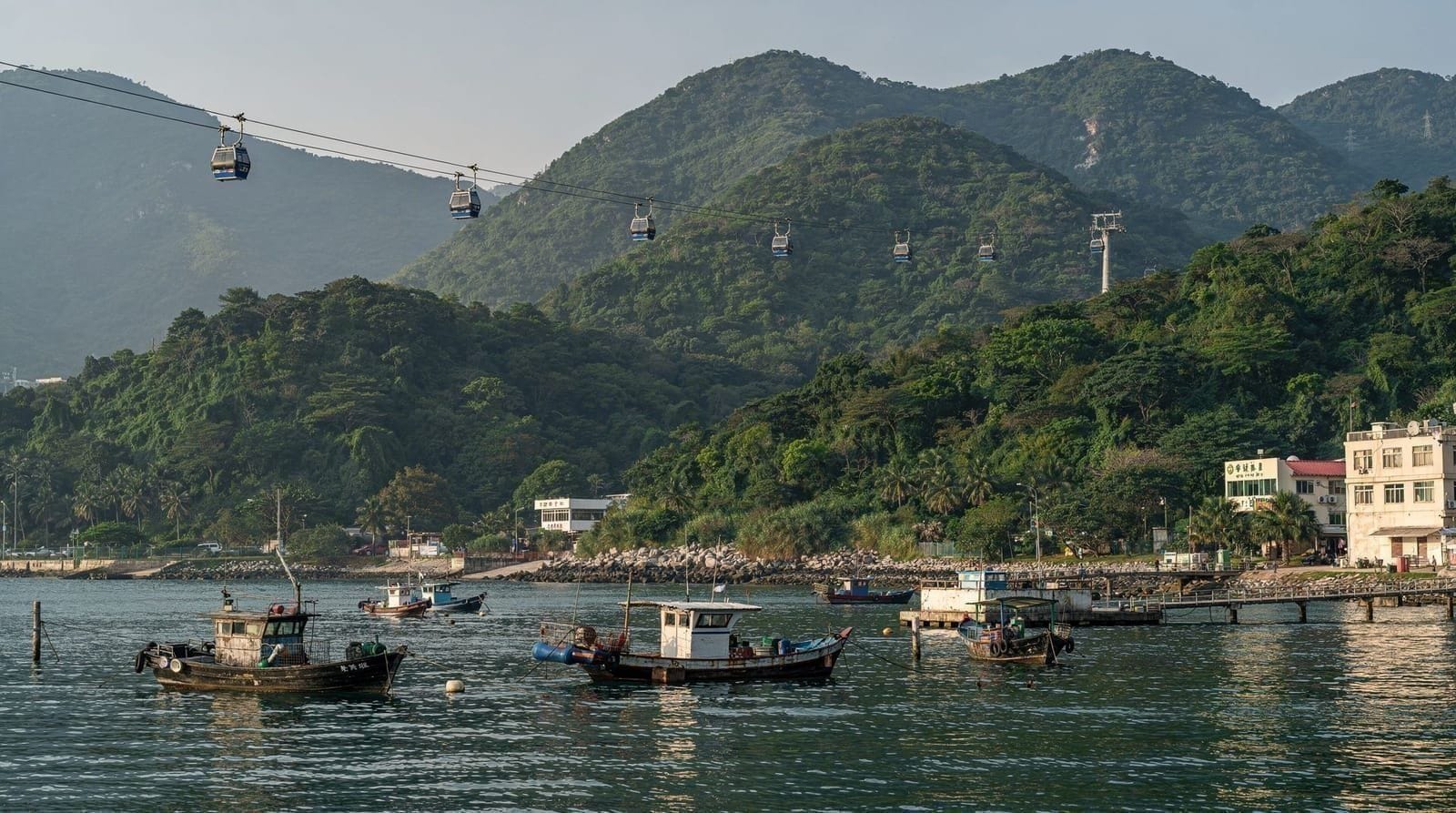
Done correctly, the visit is excellent: the cable car ride over Lantau’s forested hills and past the airport reclamation is genuinely scenic, the plateau at Ngong Ping is cooler than the city, Po Lin Monastery is free and architecturally impressive, and the views from the Buddha’s base on clear days extend across the Pearl River Delta. The Tai O combination transforms it from a landmark tick into an actual understanding of Lantau’s pre-tourism character.
This guide assumes you are planning a full day. If you only have a half-day, skip Tai O and limit yourself to Ngong Ping — 3 hours from cable car to return.
| Where | Ngong Ping, Lantau Island |
| Cost | around HK$295–365 cable car return; steps and monastery free |
| Time needed | 3 hours (Ngong Ping only) to a full day (with Tai O) |
| Getting there | MTR to Tung Chung, then Ngong Ping 360 cable car or Bus 23 |
| Best time | Weekday mornings, October–February for clear visibility |
Getting from Hong Kong to Ngong Ping
By cable car (Ngong Ping 360): The Ngong Ping 360 cable car terminal is at Tung Chung station (MTR Tung Chung Line, the same line as Hong Kong International Airport). From Hong Kong station (Central/Sheung Wan) the journey is 30 minutes. From Kowloon (Nam Cheong station) via the Tung Chung Line, about 25 minutes.
The cable car journey takes about 20 minutes each way and travels 5.7 km over Lantau Peak and the surrounding hills. Standard cabins hold 8 people and run every few minutes. Crystal cabins have glass floors; these cost more and the novelty wears off quickly for most adults — standard cabins offer identical views through the full-length windows.
Return fare: Standard HK$295, Crystal HK$365. Book online in advance to select a timed slot and avoid the queuing area entirely.
By bus (Bus 23 from Tung Chung): Bus 23 departs from Tung Chung Bus Terminus (adjacent to the MTR station) and follows a scenic mountain road to Ngong Ping. Journey time 40–50 minutes. Check the bus operator’s website for the current fare. This is the practical choice when cable car queues are long, but the route involves significant uphill switchbacks — some passengers experience motion sickness.
Organised tour: If you want to skip transport logistics, organised tours collect from major hotels in Kowloon and Hong Kong Island and include cable car tickets. The time saving is real, though the pace is set by the group.
Big Buddha tour with skip-the-line Ngong Ping 360 cable carNgong Ping Village: honest assessment
At the top of the cable car is Ngong Ping Village — a collection of shops, restaurants, and cultural facilities designed in a traditional Chinese style. It is partially commercial and partially heritage-adjacent: the Walking with Buddha exhibition (HK$30) tells the story of Siddhartha’s life and is genuinely educational; the Monkey’s Tale Theatre is aimed at children.
The retail component (souvenir shops, cafes with inflated prices) is unavoidable but brief. Walk through it toward Po Lin Monastery and the Big Buddha — this takes about 5 minutes from the cable car exit. Do not linger in the village shops unless you have children who are interested in the exhibits.
Food at Ngong Ping: Options are limited. The Po Lin Monastery restaurant serves vegetarian set lunches (check the official Po Lin site for prices); these are popular and fill up by midday. Book through the monastery reception or arrive by 11:30 to secure a table. The Ngong Ping Village restaurants serve standard Chinese food at prices 20–30% above city equivalents. Pack snacks if budget is a concern.
Po Lin Monastery
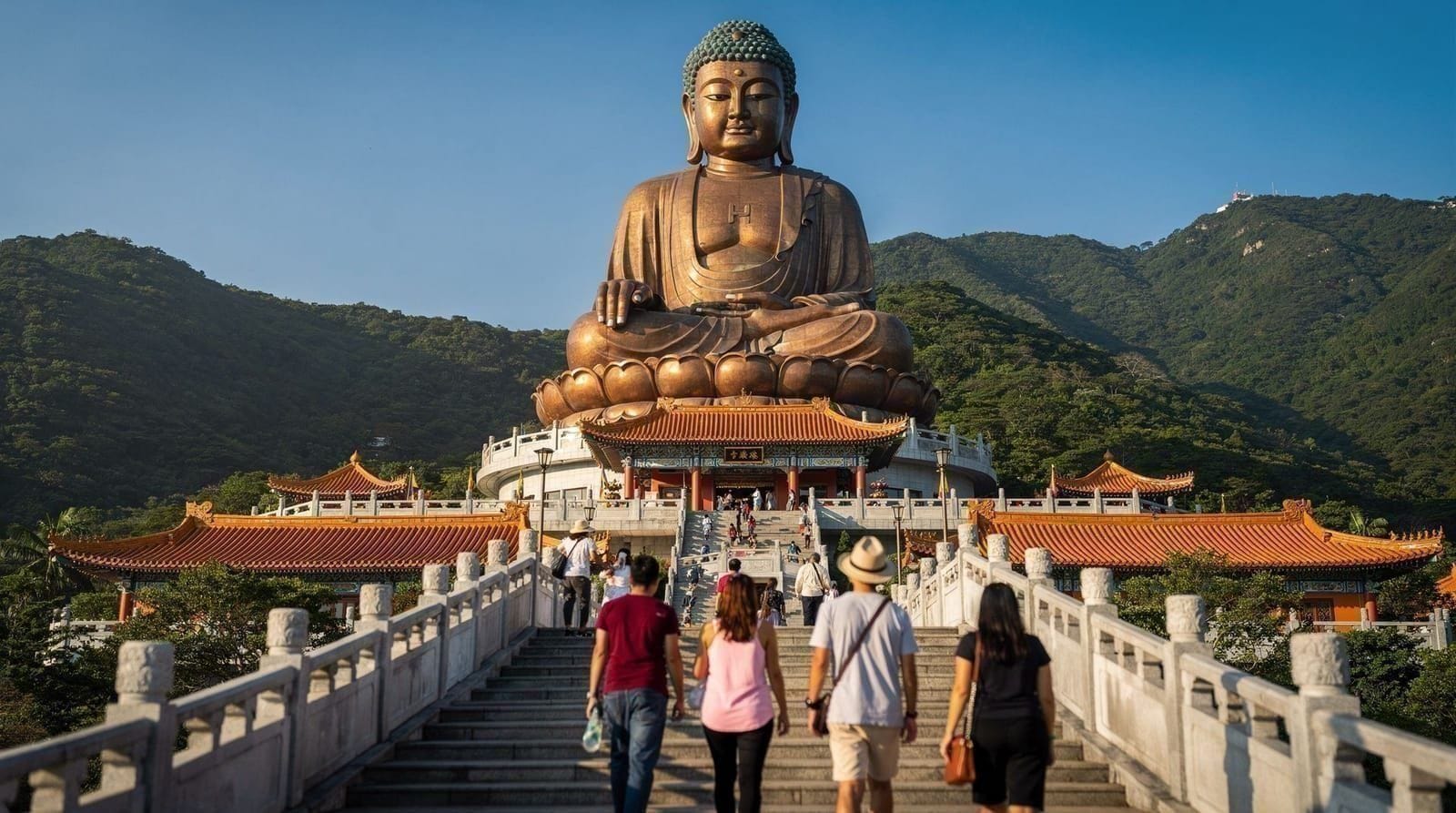
Po Lin (Precious Lotus) Monastery was established in 1906 by three Buddhist monks from Jiangnan who arrived on the then-remote Lantau plateau. The current main hall and formal buildings date to the 1970s–2000s; the older structures are largely reconstructed. It is an active monastery with resident monks, and the atmosphere varies between a tourist-friendly venue and a place of genuine monastic practice depending on the time of day.
What to see:
- Main Hall (Dazhongbao Dian): Three large gilded Buddha statues — Shakyamuni in the centre, flanked by Amitabha and Maitreya (the future Buddha). The ceiling is decorated with eight auspicious Buddhist symbols. The scale is impressive and photography is permitted outside the main altar area.
- Incense courtyard: Between the entrance gates and the main hall, a large open courtyard with incense burners. Worshippers can purchase incense for offerings.
- Teahouse: A small teahouse adjacent to the monastery entrance offers simple meals and tea at reasonable prices, though it is often full by midday.
Entry to Po Lin Monastery itself is free. The vegetarian restaurant requires either paying the admission to the Big Buddha interior package or paying separately (see the official Po Lin site for the set lunch price).
The 268 steps and the Buddha’s base
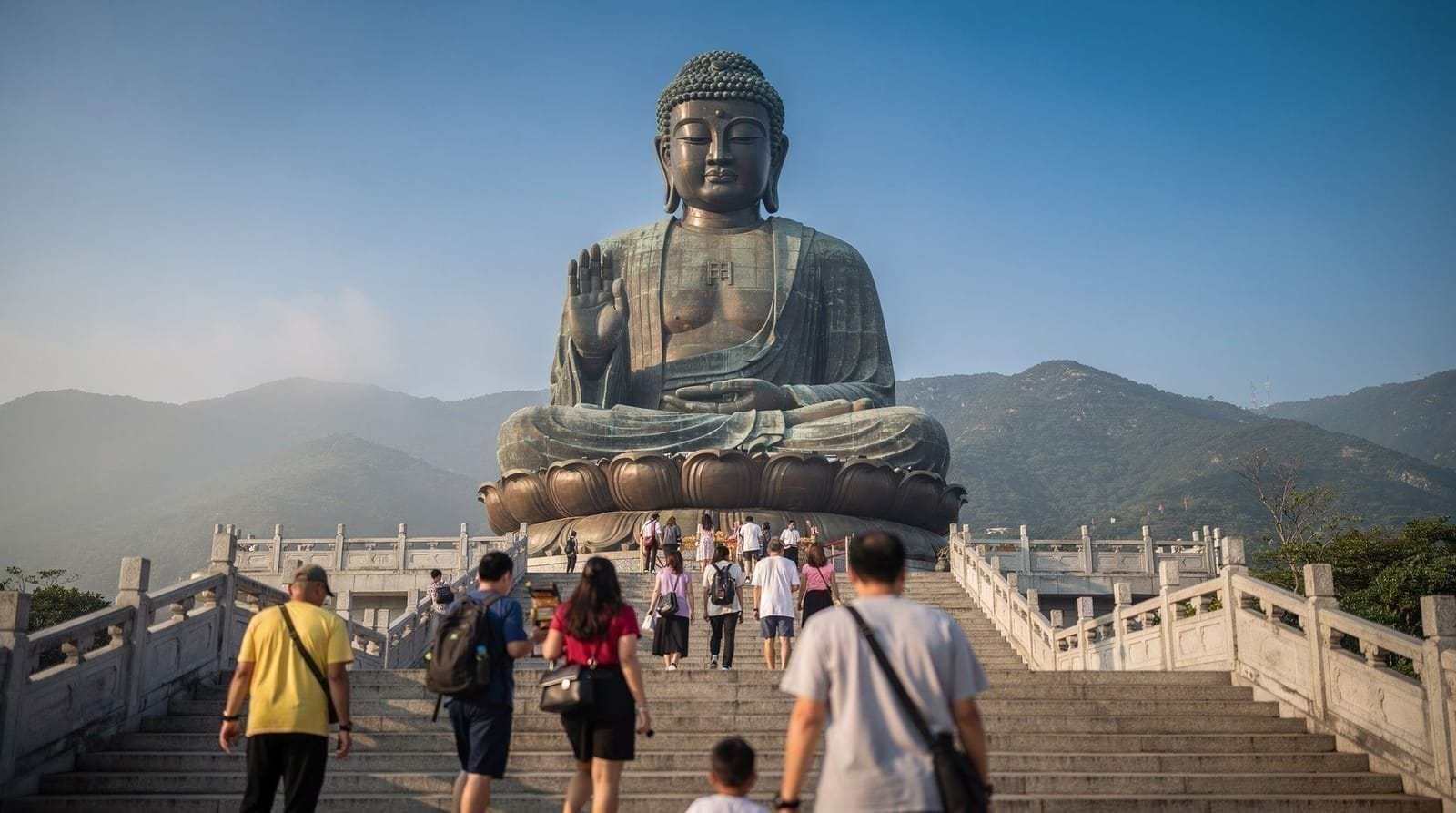
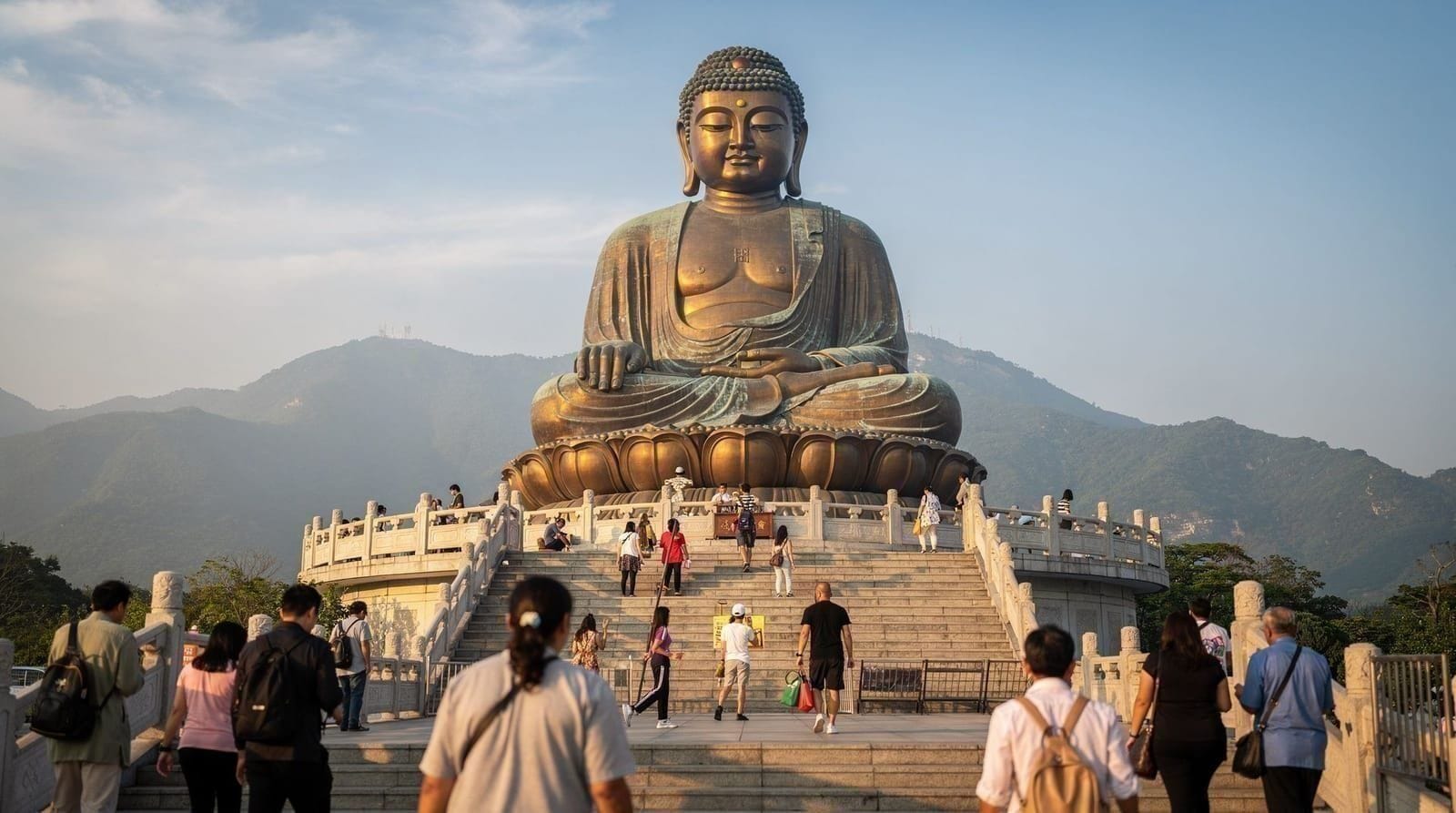
From Po Lin Monastery, a broad staircase of 268 steps leads to the three-tier lotus platform base of the Tian Tan Buddha. The climb takes 10–15 minutes at a moderate pace. The steps are wide and have railings but are fully exposed to sun and weather — bring water and sun protection.
From the base (approximately 60m above the Ngong Ping plateau), the views are good on clear days: Lantau Peak to the east, the South China Sea to the west, the Pearl River estuary on the clearest days. Pollution and haze frequently limit visibility, especially in summer. Winter (November–February) typically offers the best air clarity.
At the base are the Hall of the Universe (level 1), the Hall of Benevolent Merit (level 2), and the Hall of Remembrance (level 3). The paid interior exhibition is modest. Most visitors report that the experience of climbing the steps and seeing the Buddha from the base — which is free — is more memorable than the interior exhibition. The face of the Buddha, visible from directly below, is expressive and well-crafted at close range.
The Buddha faces north — an unusual orientation (most Buddhist temples face south), chosen to face toward China. Six smaller bronze statues on the lower platform represent “Offer to the Buddha” figures presenting offerings.
Ngong Ping 360 cable car, Tai O, and Big Buddha tourThe Wisdom Path
Ten minutes’ walk from the Big Buddha, the Wisdom Path is a series of 38 wooden columns inscribed with the Heart Sutra (a central Buddhist text) arranged in a figure-of-eight pattern on a hillside. The columns were designed by architect Liu Siu-tong in 2005. It is quieter than the main Ngong Ping area, genuinely reflective, and worth the short walk. Free entry.
Tai O: the fishing village worth the extra trip
Tai O is a Teochew fishing community on Lantau’s western coast, built partially on stilts over tidal channels. It is one of Hong Kong’s most authentically traditional settlements — not restored, not themed, genuinely functional. Shrimp paste and dried seafood are produced here; the pungent smell (shrimp paste in particular) is distinctive.
Getting there from Ngong Ping: Bus 11 from Ngong Ping (40 minutes; check the operator’s website for the fare). Return buses run roughly every 30 minutes. The last bus from Tai O back toward Tung Chung (Bus 1) runs until approximately 20:15.
What to do in Tai O:
- Walk the stilt-house channels via the pedestrian bridges
- Take a small boat tour through the channels (HK$25–35 per person from the jetty area, 20 minutes) — these are informal village operations
- Try Tai O’s local food: shrimp paste on egg (HK$30–40), snake soup in winter, dried squid. Wing Shing Bakery at the main market area sells egg waffles and local pastries.
Tai O warrants 1.5–2 hours. A half-day Ngong Ping + Tai O combination is feasible if you start the day early (Tung Chung by 09:00).
Seasonal and weather considerations
Visibility: The Big Buddha is best photographed on clear days. Hong Kong’s cleanest air occurs November–February. Summer (June–September) brings haze, typhoons, and high humidity. Check the Hong Kong Observatory website the night before — if visibility is reported as “poor” (under 5km), you will see little from the Buddha’s base and the cable car views will be diminished.
Typhoons: During typhoon warnings T3 or higher, the cable car suspends service. Bus 23 may also be affected. Check before travel.
Heat: The Ngong Ping plateau is approximately 400m above sea level and noticeably cooler than the city in summer, but still hot. The 268 steps are fully exposed. Visit early (before 10:00) or carry substantial water.
Crowds: Weekends and public holidays see cable car queues of 60–90 minutes and significantly denser crowds at the Ngong Ping plateau. Chinese New Year, Easter, and Golden Week (early October) are peak times. Weekday mornings between October and February are the optimal combination of good weather, manageable crowds, and clear visibility.
Lantau VIP priority cable car, Big Buddha, and Tai O tourPractical costs breakdown
| Item | Cost (HKD) |
|---|---|
| MTR to Tung Chung | see the MTR fare calculator for your origin |
| Cable car return (standard) | HK$295 |
| Cable car return (crystal) | HK$365 |
| Bus 23 (each way) | see the bus operator’s website |
| Buddha interior exhibition | see the official Po Lin site |
| Po Lin vegetarian lunch | see the official Po Lin site |
| Bus 11 to Tai O | see the bus operator’s website |
| Tai O boat tour | HK$25–35 |
The cable car is the main cost of the day (HK$295 standard return); add MTR and bus fares, lunch, and the optional interior exhibition. Taking the bus both ways instead of the cable car lowers the total noticeably.
Fitting the Big Buddha into a wider trip
The Big Buddha works best when it is placed deliberately rather than squeezed in. If you are still deciding how to structure your days, the Lantau Big Buddha day trip guide lays out the day in sequence, and the Ngong Ping Big Buddha destination page gives the place-focused overview. For the wider island, the Lantau Island destination page and the Tai O destination page help you decide how much of the west coast to add.
Many travellers slot the visit into a longer plan such as the Hong Kong 3 days itinerary or the first-timer itinerary, where it usually takes one of the days on its own. Because the Tung Chung line is also the airport line, the airport to city guide is useful if you plan to visit on arrival or departure day.
Lantau Trail context
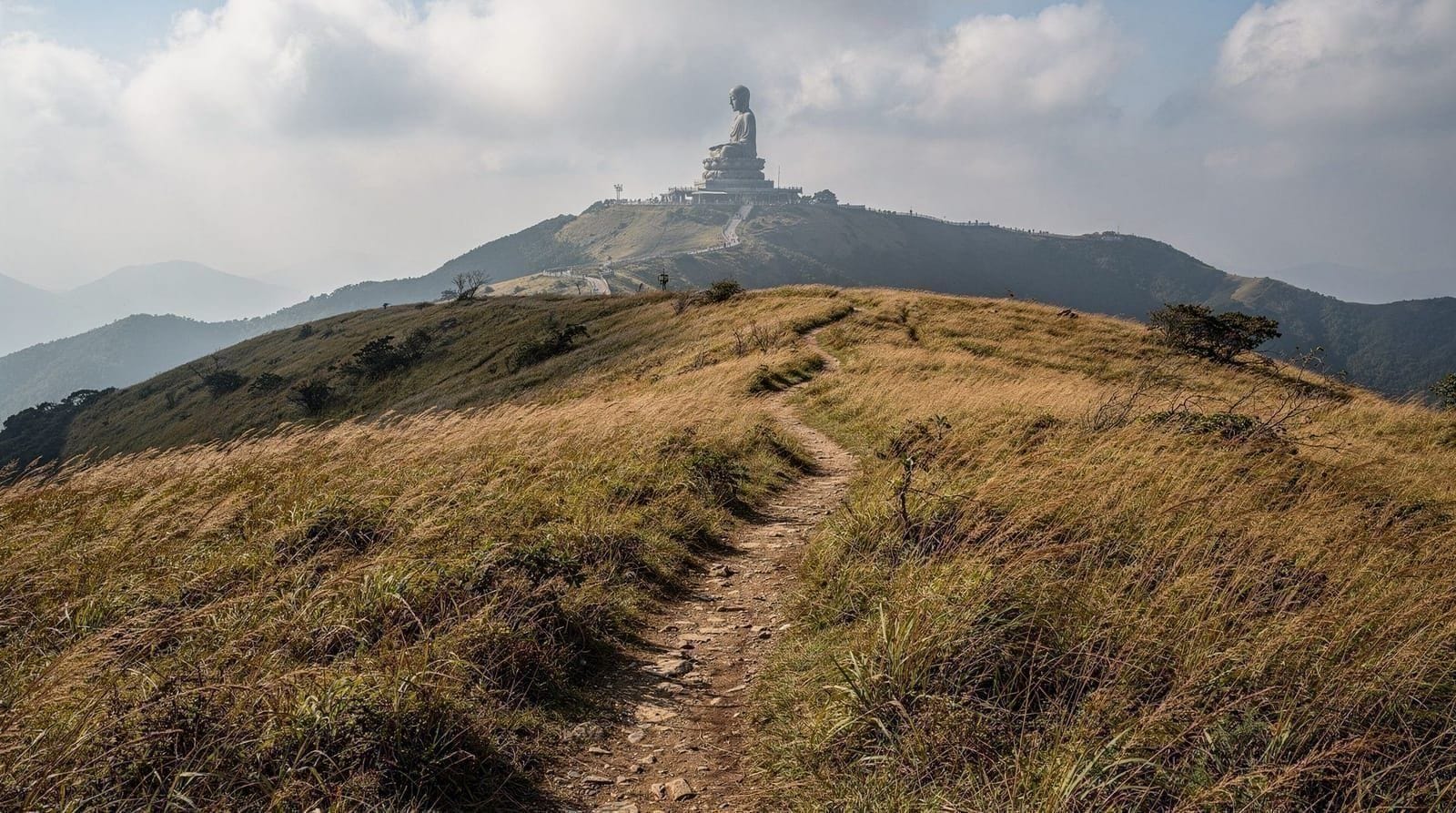
If you are interested in Lantau’s hiking, the Lantau Trail guide covers the 70km circuit route and which sections are accessible as day hikes. Section 3 of the Lantau Trail crosses the Ngong Ping plateau and can be combined with a Big Buddha visit for hikers who want more than just the monument. The trail from Ngong Ping to Lantau Peak (934m) is a 3-4 hour additional hike for fit walkers.
The best hikes in Hong Kong guide places the Lantau options in context relative to Dragon’s Back, Lion Rock, and Sai Kung.
What surprises first-time visitors
A few things about the Big Buddha catch first-timers off guard. The statue faces north rather than south, toward mainland China — a deliberate design choice unusual for Buddhist statuary, and one that’s easy to miss unless you already know to look for it. The plateau at Ngong Ping is genuinely cooler than central Hong Kong thanks to its 400m elevation, which surprises visitors who packed for city heat and find themselves underdressed on a breezy day.
And despite the scale of the operation — the cable car, the village, the crowds — the actual climb to the Buddha’s base and the Po Lin Monastery grounds retain a real sense of religious activity; incense smoke, chanting from the halls, and monks going about daily business are all part of the visit, not staged for tourists.
Big Buddha vs Hong Kong’s other big-day-out temples
Lantau’s Big Buddha is often the single most time-consuming attraction in a Hong Kong itinerary, so it’s worth knowing how it compares to the alternatives before committing a full day to it. Ten Thousand Buddhas Monastery in Sha Tin is a half-day rather than a full day, free throughout, and offers a completely different visual experience — thousands of statues on a staircase rather than a single monumental bronze figure. Wong Tai Sin Temple is a 20-minute MTR-accessible visit with none of the travel logistics.
Choose the Big Buddha specifically if you want the combination of cable car scenery, a genuinely monumental statue, and — if you extend to Tai O — a traditional fishing village that nothing else on this list offers. If your time in Hong Kong is short and you have to pick one, the Big Buddha’s travel time makes it the highest-commitment option of the three, so weigh it against your remaining itinerary in how many days in Hong Kong.
Timing your visit around the cable car and the sun
Because the plateau at Ngong Ping faces largely west and north, the light and the crowds move together through the day in a predictable way. Early morning (cable car opens around 10:00 on weekdays) gives the softest light on the Buddha’s face and the shortest queues, but the monastery restaurant isn’t yet serving lunch. Midday brings the largest crowds and harsher overhead light, worse for photography of the statue’s expression. Late afternoon softens the light again but risks the last cable car back if you’ve also gone to Tai O — check the final departure time before you commit to the full day, as missing it means a much longer bus-only return via Tung Chung.
Travelling with kids or limited mobility to Ngong Ping
The cable car cabins are enclosed, stable, and generally comfortable for children, though the 20-minute ride with no stop can be a long stretch for toddlers prone to motion sickness — Bus 23’s switchback mountain road is worse in this respect and best avoided with young children who get carsick.
The 268 steps to the Buddha’s base have no lift or alternative accessible route; visitors using wheelchairs or with significant mobility limitations should be aware that the base viewing area and Po Lin Monastery grounds are reachable without the steps, but the Buddha’s platform itself is not. The Ngong Ping Village with kids guide covers pushchair-friendly routes through the village and monastery grounds in more detail.
Ngong Ping 360 cable car return ticketsFrequently asked questions about Tian Tan Big Buddha guide — Ngong Ping, cable car, and Po Lin Monastery
Should I take the cable car or bus to Ngong Ping?
What does it cost to visit the Big Buddha?
How tall is the Tian Tan Big Buddha?
What is inside the Big Buddha?
Is Po Lin Monastery worth visiting?
Should I combine the Big Buddha with Tai O fishing village?
What are the cable car queues like?
Is the Big Buddha visit suitable for young children?
Top experiences
Bookable activities with verified prices and instant confirmation on GetYourGuide.