Star Ferry and trams guide — crossing Victoria Harbour and riding the Ding Dings
Hong Kong: Star Ferry A Symphony of Lights evening cruise
How much does the Star Ferry cost and which deck should I take?
The Star Ferry adult fare on the Central–Tsim Sha Tsui crossing is HKD 4.0 on the lower deck or HKD 5.0 on the upper deck Monday to Friday, and HKD 5.6 or HKD 6.5 at weekends and public holidays. Take the upper deck every time — the views across Victoria Harbour are the point. The crossing takes 8 minutes and runs approximately every 6–12 minutes from 06:30 to 23:30.
Two of Hong Kong’s oldest and most iconic ways to move
Some cities have transport systems. Hong Kong has the Star Ferry and the trams — two forms of public transit that happen to be among the finest urban experiences anywhere in the world. The Star Ferry has been crossing Victoria Harbour since 1888. The trams — affectionately called Ding Dings for the bell that signals stops — have been rattling along Hong Kong Island’s north shore since 1904. Both are still used by commuters every single day. Both cost under HKD 7 per ride.
This guide covers everything practical you need to use them confidently — fares, routes, timings, which deck to sit on, where to board — plus the best strategies for turning a functional journey into a genuine Hong Kong memory.
| Star Ferry cost | HKD 4.0–6.5 depending on deck and day, 8-minute crossing |
| Tram cost | HKD 3.30 flat fare, any distance |
| Star Ferry hours | 06:30–23:30, every 6–12 minutes |
| Tram hours | approx. 05:10–midnight |
| Payment | Octopus card or exact cash on both |
| Best pairing | Star Ferry at sunset + tram through Wan Chai/Causeway Bay |
Why locals still use both every day
It would be easy to assume the Star Ferry and the trams survive purely on tourist nostalgia, but that isn’t the case. Both remain genuinely functional transit for hundreds of thousands of daily trips. Office workers cross on the Star Ferry because it is faster door-to-door than descending into an MTR station on either side; residents of Kennedy Town, Western, and the eastern districts take the tram because a flat HKD 3.30 fare beats the MTR for short hops, even if it is slower. This matters for visitors because it means you are not riding a museum piece kept alive for photographs — you are sharing the ride with the city doing its actual daily business, which is part of what makes both experiences feel authentic rather than staged.
Star Ferry vs tram vs MTR: which for which journey
All three run on the same Octopus card, but they solve different problems. Use this to decide which to take before you plan a route:
| Journey | Best option | Why |
|---|---|---|
| Crossing Victoria Harbour | Star Ferry | Only one with the view; MTR is faster but underground |
| Along Hong Kong Island’s north shore (Kennedy Town–Shau Kei Wan) | Tram | Street-level, cheap, scenic; MTR is faster if you’re in a hurry |
| Central to Causeway Bay in under 10 minutes | MTR | Tram can take 20–30 minutes in traffic |
| Sightseeing with no fixed schedule | Tram or Star Ferry | Both are transport that doubles as the attraction |
| Airport or cross-border connections | MTR | Neither the ferry nor the tram reaches the airport or the border |
The Star Ferry: eight minutes that feel like much more
What makes the crossing special
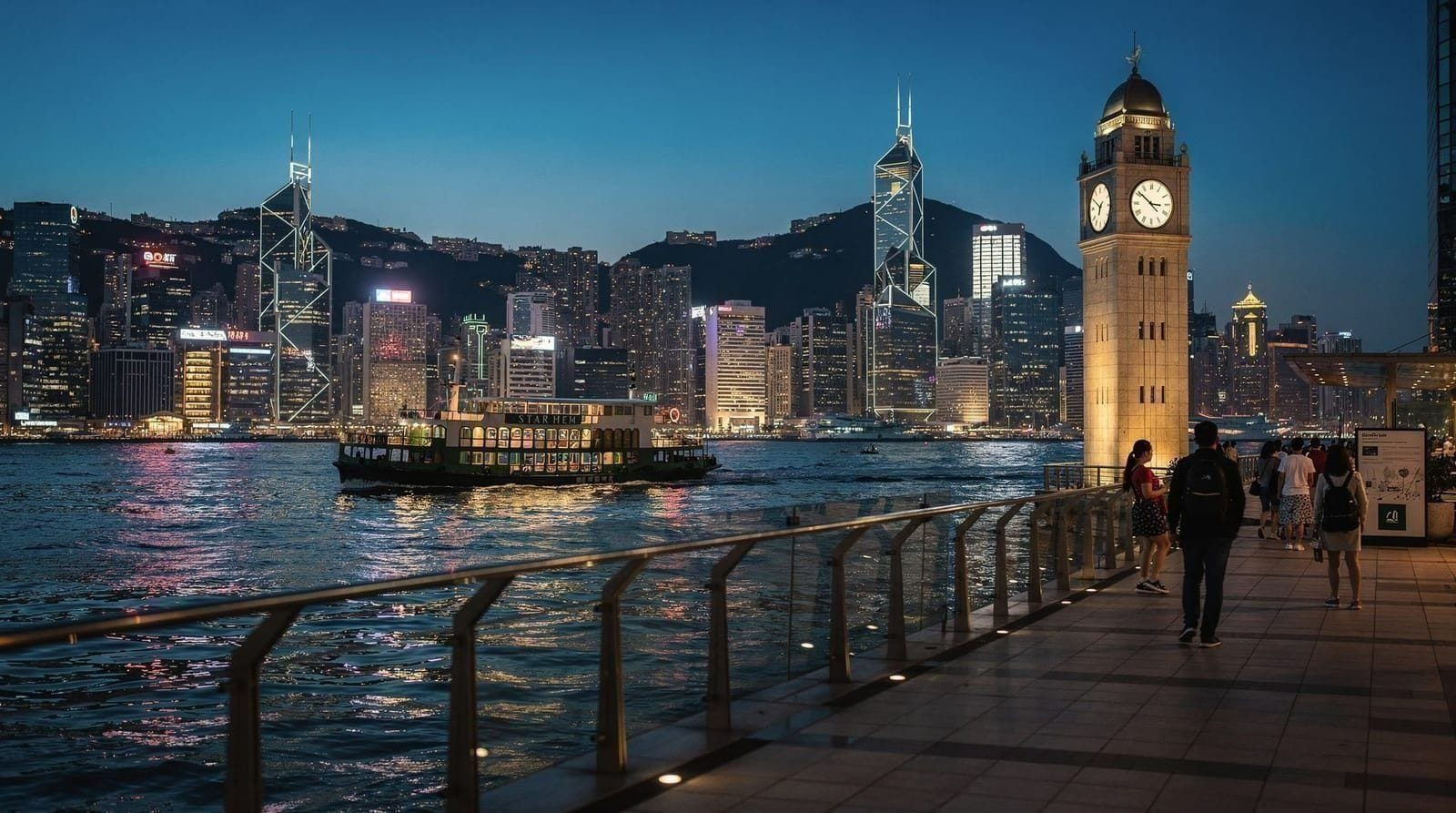
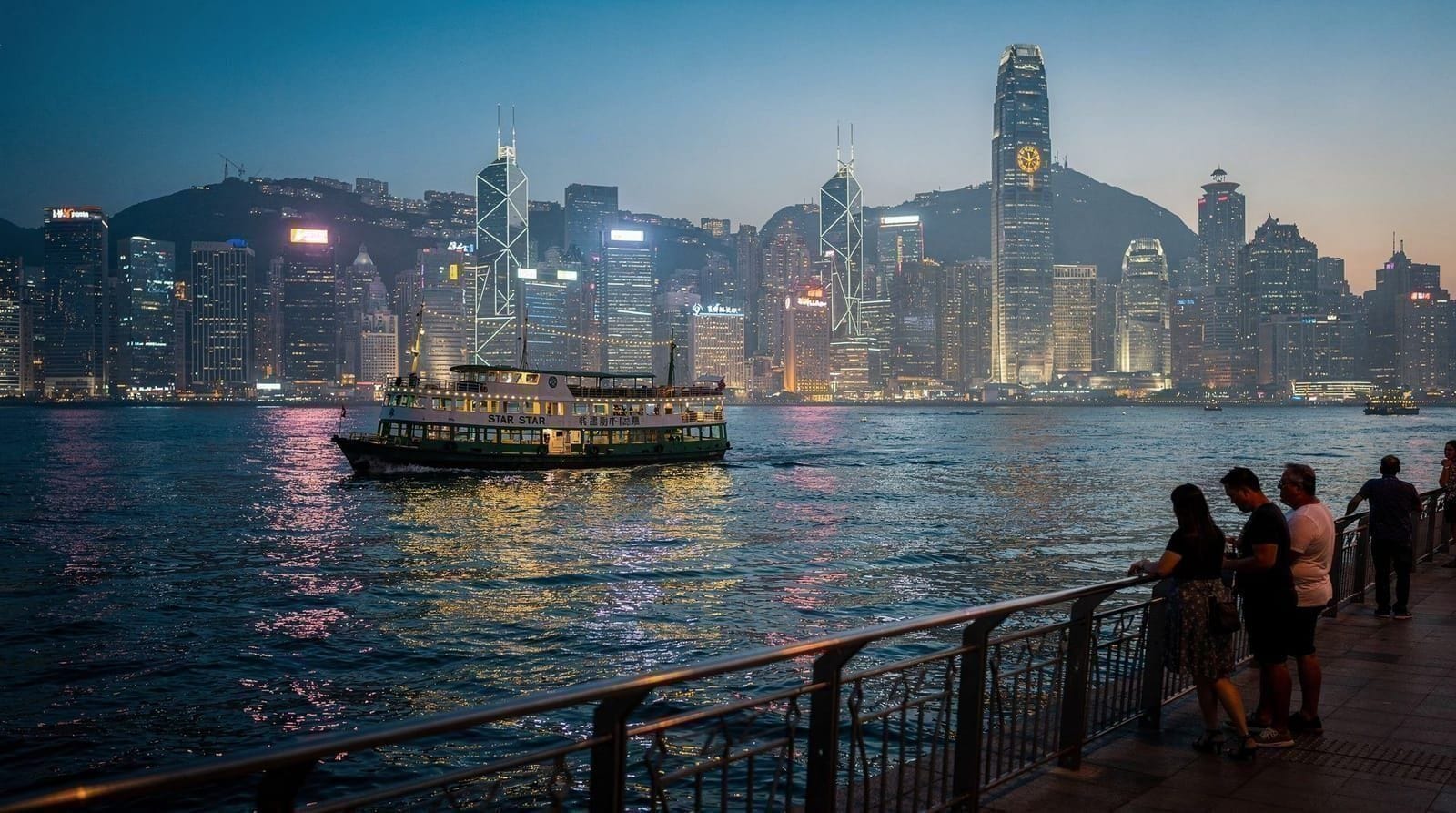
Victoria Harbour is one of the world’s great natural harbours, and crossing it by ferry gives you something no elevated highway or underground tunnel can: an unobstructed, water-level view of both skylines simultaneously. To the south, the towers of Central, Admiralty, and Wan Chai climb steeply from the waterfront to the ridgeline of Hong Kong Island. To the north, the Tsim Sha Tsui waterfront of Kowloon stretches in a lower, more horizontal line punctuated by hotels and the distinctive Clock Tower. The eight-minute crossing gives you time to take it in properly.
In 1997, the Time magazine named the Star Ferry one of the top 50 travel experiences in the world. That designation holds. But this is not a tourist attraction that exists purely for tourism — the green-and-white ferries are part of Hong Kong’s functional transit network, and the people alongside you on the upper deck include office workers, students, and elderly residents who have been making this crossing for decades.
Routes and how to read the piers
There are two Star Ferry crossings currently in operation:
Central (Pier 7) to Tsim Sha Tsui Star Ferry Pier: The main crossing. Eight minutes, departing every 6–12 minutes. This is the route most visitors take, and the harbour views are excellent in both directions. Central Pier 7 is at the western end of the Hong Kong waterfront promenade, a 10-minute walk from Central MTR exit A or reachable via the elevated walkway system from Exchange Square.
Wan Chai Pier to Tsim Sha Tsui Star Ferry Pier: The secondary crossing, taking approximately 12 minutes. Less busy than the Central route, and useful if you are already in Wan Chai. The Wan Chai pier is off Harbour Road, about a 10-minute walk north from Wan Chai MTR exit A1. Both routes serve the same Tsim Sha Tsui pier on the Kowloon side.
Both routes run from approximately 06:30 to 23:30 daily.
Upper deck vs lower deck
Always choose the upper deck. The fare difference is about HKD 1 (HKD 5.0 versus HKD 4.0 Monday to Friday; HKD 6.5 versus HKD 5.6 at weekends and public holidays). For that amount you get significantly better views, more open air, and the distinctive experience of the old wooden benches and brass fittings that define the Star Ferry interior. The lower deck exists and is perfectly functional but offers restricted sightlines through the portholes rather than open window views. There is no practical reason to choose it unless the upper deck is unusually busy during peak commuter hours.
How to board: the turnstile and Octopus procedure
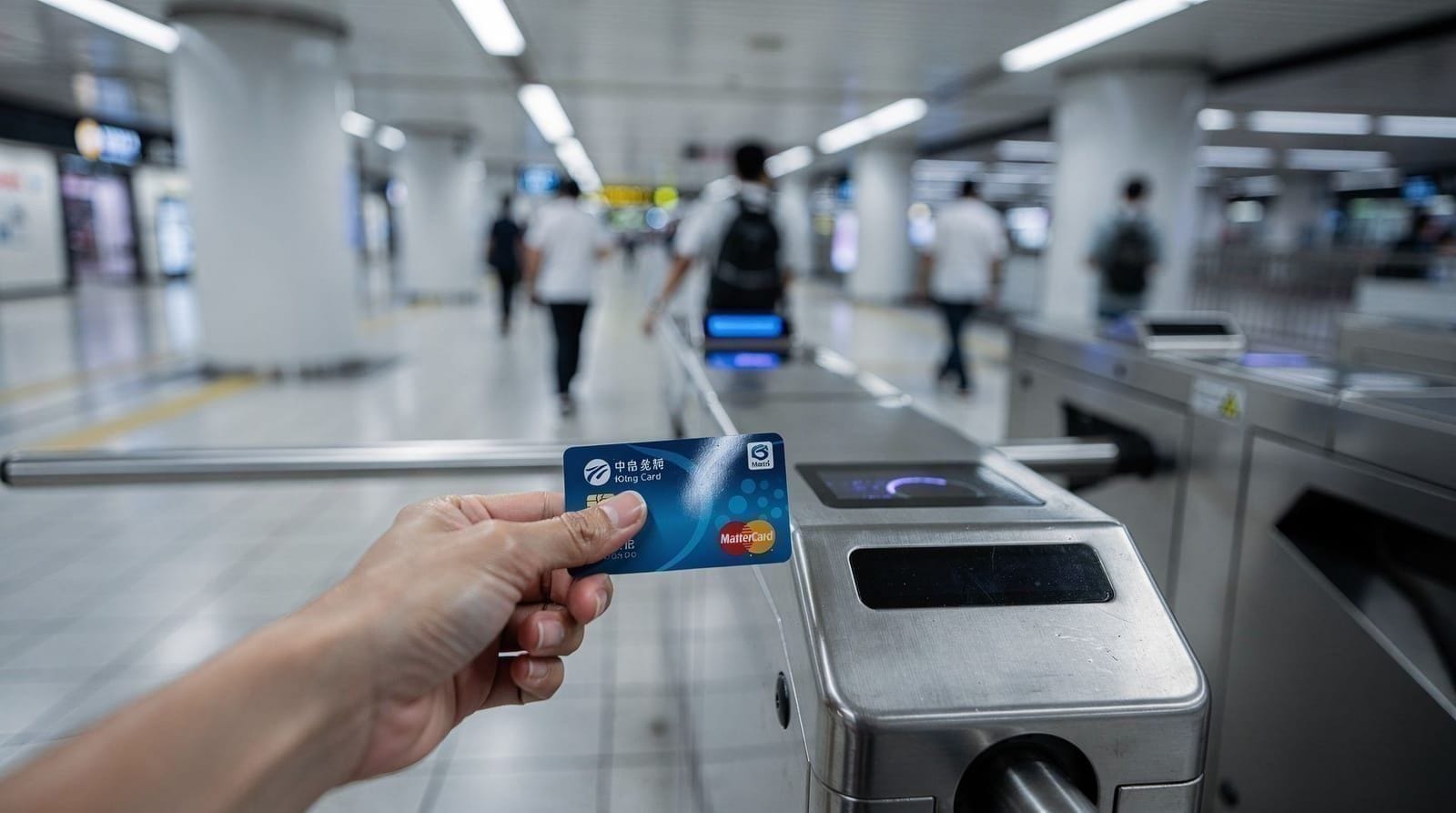
On the Central pier side, you enter through a turnstile before reaching the boarding area. Tap your Octopus card at the reader mounted on the turnstile — the fare is deducted at this point, not when you board the ferry. If paying cash, buy a ticket at the small booth adjacent to the turnstile first, then use it to pass through. Once through the turnstile, wait in the covered boarding area until the ferry docks and the gangway lowers. Boarding is a slight shuffle but orderly — there is no reserved seating on the ferry, first aboard takes the best spots.
If you want a forward-facing window seat on the upper deck, be among the first to board and walk to the prow. If you prefer to photograph the skyline receding behind you as you cross, sit toward the stern. Both are good. The crossing is short enough that it barely matters.
For getting an Octopus card if you do not already have one, see our full guide — it covers how to buy one at the airport and what the deposit covers. All Star Ferry fares can be paid by Octopus.
Best time to cross
Symphony of Lights at 20:00: Every night at 8pm, the buildings along both sides of Victoria Harbour participate in a coordinated light and laser show that runs for approximately 10 minutes. The show is best viewed from the water. Taking the ferry — either the standard crossing or a dedicated cruise — during the 20:00 show is the single best way to experience it. The standard crossing lasts 8 minutes, which means you catch a good portion of the show mid-harbour. If you want the full 10-minute experience without having to rush, a dedicated cruise is more appropriate.
Star Ferry Symphony of Lights harbour cruiseSunset: In summer (April–September), sunset falls roughly between 19:00 and 19:30. In winter (November–February), closer to 17:45–18:15. The harbour catches the light beautifully at both ends of this window, with warm tones on the glass towers of Hong Kong Island. Crossing at sunset and crossing back during the Symphony of Lights makes for an excellent pairing if you are basing yourself in Tsim Sha Tsui for the evening.
Star Ferry sunset harbour cruiseMorning clarity: Clear days in autumn and winter (October–February) often have exceptional visibility and relatively low humidity. A morning crossing before 09:00 on a clear day gives you sharp views of the skyline against a blue sky, with fewer crowds than evening.
Star Ferry cruises vs the standard crossing
If you want a more extended harbour experience, dedicated sightseeing cruises operate from the pier area. These are separate from the regular commuter service and typically run 45–60 minutes, covering the full width of the harbour and sometimes looping past the western anchorages. They include narration and usually offer open upper viewing decks. The Symphony of Lights cruise is timed precisely around the 20:00 show. A half-day tour that combines the Peak Tram and Star Ferry is a practical way to cover two iconic experiences in one guided session if you are short on time.
Half-day city highlights tour with Peak Tram and Star FerryFor the rest of your time on the water, see Hong Kong island ferries guide which covers routes to the outlying islands.
What’s around each pier
Central Pier 7 (Hong Kong Island side): The waterfront promenade extends east from the ferry piers past Pier 9 and Pier 10 (outlying island ferries), with views across to Kowloon. The IFC Mall and Exchange Square are a 5-minute walk via the elevated walkway. To head into Central and Sheung Wan from here, walk south on Connaught Road or use the pedestrian bridges. The Central vs Tsim Sha Tsui guide covers the neighbourhood context for both ends of this crossing.
Tsim Sha Tsui Star Ferry Pier (Kowloon side): The Avenue of Stars runs along the waterfront in front of the pier — the dedicated promenade for the Symphony of Lights viewing, lined with handprints of Hong Kong film stars. The Clock Tower, a remnant of the old Kowloon–Canton Railway terminus, is immediately adjacent. Nathan Road, the main commercial spine of Tsim Sha Tsui, is a 5-minute walk north. The Tsim Sha Tsui MTR station (Tsuen Wan and Kwun Tong Lines) is about 8 minutes on foot.
Hong Kong trams: the Ding Dings
A city’s oldest transport, still working
The trams began operating in 1904. They are older than Hong Kong’s bus network, older than the MTR by more than 70 years, and they have outlasted most of the buildings they trundled past in the early 20th century. The double-decker trams running today are technically updated versions of the originals, but the experience of riding them — the narrow body, the wooden seat backs upstairs, the bell, the eye-level view of Hennessy Road or Des Voeux Road at 15 km/h — has remained essentially constant for over a century.
The nickname Ding Ding comes from the driver’s bell, which rings to signal stops, warn pedestrians, and alert other trams. You will hear it constantly. It is impossible not to smile at it.
The route: Kennedy Town to Shau Kei Wan
The tram network runs 13km along the north coast of Hong Kong Island, essentially following the original colonial-era waterfront (much of which has since been reclaimed). The main east–west line connects Kennedy Town in the west to Shau Kei Wan in the east. A branch loops south through Happy Valley — relevant if you are heading to the races.
Not all trams run the full route. At the front of each tram, a destination board shows the terminus — look for the Chinese characters or the romanised name. Common destinations you will see include:
- Kennedy Town (Western terminus)
- Shau Kei Wan (Eastern terminus)
- Happy Valley (Loop branch, not east–west)
- Causeway Bay (Partial route)
- Whitty Street (Near Kennedy Town area)
Key stops along the main route, west to east:
Kennedy Town — western terminus; a lively residential area with wet markets and the MTR Kennedy Town station (Island Line extension opened 2014).
Western Market — a handsome Edwardian building near Sheung Wan now housing fabric stalls; good stop for exploring Sheung Wan.
Des Voeux Road Central — heart of the financial district; the tram shares the road with buses and taxis through here, often moving slowly during peak hours. Central MTR station is a short walk south.
Wan Chai — busy commercial and entertainment district; the tram stops along Johnston Road and Hennessy Road give good access to the street-level life of Wan Chai. An easy starting point for the causeway bay area guide is a tram stop east of here.
Causeway Bay — the busiest shopping district on Hong Kong Island; the tram creeps through here, which is fine for sightseeing, painful if you need to be somewhere quickly.
Tin Hau — quieter residential neighbourhood; the Tin Hau Temple (goddess of the sea) is nearby.
Shau Kei Wan — eastern terminus; historic fishing village feel, the Tam Kung Temple, and the start of the Dragon’s Back hiking trail. MTR Shau Kei Wan station (Island Line) is adjacent.
How to ride: board front, exit rear
The boarding procedure catches first-timers out. Unlike Hong Kong’s buses where you pay on entry, on the trams you pay when you leave:
- Board at the front of the tram, from the front doors.
- Find a seat — go upstairs for the views.
- When you want to get off, press the stop button (or wait for the conductor’s bell), then move to the rear doors at the back of the tram.
- Pay on exit: tap your Octopus card on the reader at the rear, or drop HKD 3.30 exact coins into the cash fare box. The box does not give change. The Octopus fare is a flat HKD 3.30 regardless of distance.
The rear door is at the back of the ground-floor level. Do not try to exit via the front — you will confuse the boarding flow and the driver will not thank you.
Upstairs always
The top deck of a Hong Kong tram is one of the best free viewpoints in the city. You sit approximately 4 metres above street level, at eye height with the first floors of the shophouses and commercial buildings lining Hennessy Road and Des Voeux Road. Neon signs — increasingly rare but still present in Causeway Bay and Wan Chai — pass at arm’s length. The narrow width of the trams means the buildings on each side feel very close. On a rainy day the windows steam up pleasantly; on a clear day you can see the hills behind the north shore rising steeply. It is, in short, an excellent perch.
When not to take the tram
The tram is not the right tool for every journey. Specific situations where the MTR is clearly better:
Rush hours in Central and Causeway Bay: Between 08:00–09:30 and 18:00–19:30, the trams through the commercial core can be so slow that a 3km journey takes 45 minutes. The MTR covers the same ground in 4 minutes.
When you need to cross the harbour: Trams run only on Hong Kong Island. For Kowloon, take the Star Ferry or MTR.
Rain + peak hours: The combination makes tram travel genuinely unpleasant. The narrow aisles get crowded and wet, and progress is especially slow.
Outside these situations — particularly for leisurely exploration of Wan Chai, Causeway Bay, and the quieter eastern sections — the tram is excellent. It is also the right choice when you have no particular schedule and want to understand the street-level texture of Hong Kong Island at a human pace.
Happy Valley branch and race days
A branch of the tram network swings south through Happy Valley, the horse-racing venue that is one of Hong Kong’s great social institutions. On race days — Wednesday evenings and some weekends during the season (September–July) — the trams to Happy Valley fill with racegoers. The Happy Valley Racecourse has a free public viewing area on the eastern stand for those who want to watch without purchasing tickets, and the atmosphere on a race night is unlike anywhere else in the city.
If you are visiting Hong Kong Island and want to understand what makes the city work at a social level, a race night at Happy Valley (accessible by tram from Causeway Bay or Wan Chai) is as revealing as any museum.
Tram hours and service frequency
Trams run from approximately 05:10 to midnight. Frequency depends on the time of day — every 2–3 minutes at peak hours on busy sections, every 5–8 minutes on quieter sections and at off-peak times. The network does not have a published timetable in the traditional sense; at busy stops, the wait is rarely more than a few minutes during daylight hours.
The flat fare of HKD 3.30 applies regardless of when you travel or how far you go. There is no peak pricing and no minimum distance.
Practical notes on the Octopus card
Both the Star Ferry and the trams accept Octopus as the primary payment method. If you are arriving in Hong Kong and want to use both immediately, picking up an Octopus card at the airport is the most efficient approach. Our Octopus card guide covers how to buy one, how much to load, and how the transit discount system works. An Octopus card costs HKD 200 (HKD 50 refundable deposit plus HKD 150 stored value) from any MTR station or at the Airport Express arrivals hall.
For a full picture of Hong Kong’s public transport options, including the MTR network that connects the trams to the outlying islands ferries, see the Hong Kong MTR guide.
Using the trams and Star Ferry as a day structure
A practical way to organise a Hong Kong Island day that uses both:
Start at Kennedy Town or Western Market (tram from wherever you are staying in the west). Ride the tram east to Des Voeux Road Central to begin exploring Soho and Central. Board again later and ride through Wan Chai to Causeway Bay for lunch or shopping. In the afternoon, walk north from Causeway Bay toward the waterfront and take the Star Ferry to Tsim Sha Tsui, arriving in time for the Avenue of Stars and the 20:00 Symphony of Lights. Return via Star Ferry and head for dinner in Wan Chai or Causeway Bay — reachable by tram again.
This route uses no MTR, costs under HKD 30 in fares for all transit, and covers a substantial amount of what makes Hong Kong interesting. It pairs naturally with the Peak Tram, which you can add as a morning activity before the tram journey begins, or an evening activity after returning from Kowloon. The one-day Hong Kong itinerary builds on this structure with timing and restaurant suggestions.
Connections to outlying islands and day trips
The Star Ferry terminal at Central Pier 7 is adjacent to the outlying island ferry piers (Piers 5, 6, and beyond). After crossing from Tsim Sha Tsui, it is a short walk along the waterfront to board ferries to Lantau Island, Lamma Island, or Cheung Chau. If you are planning a Big Buddha day trip or visiting Lamma Island or Cheung Chau, the Star Ferry crossing to Central is often the beginning of that journey.
For the full context of what those ferries offer, see Hong Kong outlying islands guide.
For day trips from Hong Kong that involve crossing borders — such as a day in Shenzhen or the Macau day trip — you will need different transport entirely; the Star Ferry does not cross those distances. But structurally, the Star Ferry is where Hong Kong’s day-trip geography begins.
Travelling with kids and with limited mobility
Both are good options for families. Children generally love the Star Ferry — the horn, the gap between the gangway and the boat, the open deck — and the 8-minute crossing is short enough that restlessness isn’t an issue. Hold hands near the open railings on the upper deck and at the gangway when boarding. The trams are more of a mixed bag with small children: the stairs to the upper deck are steep and narrow, and a pram cannot go up, so if you want the top-deck view with a stroller, one adult needs to carry the child while the other manages the pram on the lower deck.
For accessibility, the Star Ferry piers have ramps and lifts to the gangway level, and the ferries themselves have level boarding at most tide levels, though a small step can appear at very low or high tide. The trams are less accommodating — the boarding step at the front and rear doors is fixed and moderately high, and there is no ramp or lift to the upper deck. Wheelchair users and anyone with significant mobility limitations should treat the MTR as the primary option for crossing the harbour and moving along Hong Kong Island, using the Star Ferry only if assistance is available at the pier.
What to do if the weather turns
Both the Star Ferry and the trams are outdoor-adjacent transit, and Hong Kong’s weather can interrupt either. The Star Ferry suspends service once Typhoon Signal 8 is hoisted, and can be choppy (though still running) under Signal 3 — if you are prone to seasickness, take the MTR instead on a blustery day. Heavy rain does not stop the ferry, but the open sections of the upper deck get wet; stand toward the covered centre if you want to stay dry while keeping the view.
The trams keep running in all but the most severe weather, though a downpour during rush hour is one of the least pleasant ways to travel in the city — the aisles get crowded and damp, and progress slows further than usual. On a wash-out day, treat the Hong Kong MTR as the fallback for both crossings and island travel, and save the ferry and tram rides for clearer weather.
Etiquette and small things first-timers get wrong
Board the tram from the front and exit from the rear — doing it backwards confuses the queue behind you and occasionally draws a sharp word from the driver. On the Star Ferry, there is no assigned seating and no need to queue in a formal line once through the turnstile, but do let arriving passengers off before you board. Standing at the very front railing of the tram’s upper deck for an extended photo session blocks the aisle for people trying to reach the stairs — a quick photo is fine, lingering is not.
On both forms of transport, priority seating exists for elderly and disabled passengers near the doors; Hong Kong takes this seriously even when the vehicle is crowded. Finally, neither the ferry nor the tram accepts credit cards or mobile payment at the point of boarding — arrive with a loaded Octopus card or exact coins, not a wallet full of notes.
Half-day Peak Tram and Star Ferry combo tourFrequently asked questions about Star Ferry and trams guide — crossing Victoria Harbour and riding the Ding Dings
How do I pay for the Star Ferry?
What is the difference between the Central and Wan Chai Star Ferry routes?
What time is best to take the Star Ferry?
Are there Star Ferry harbour cruises separate from the regular service?
How do I ride the Hong Kong trams?
How slow are the trams really?
What is the tram route and what are the key stops?
Do I need a separate card or ticket for the trams?
Top experiences
Bookable activities with verified prices and instant confirmation on GetYourGuide.